A Sharper Look at a Supernova Seen in 1181
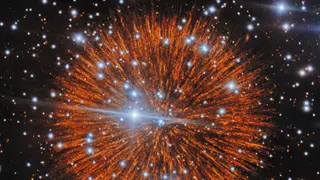
Astronomers have released the clearest image yet of the Pa 30 nebula, the leftover of a supernova that people recorded on Earth in 1181. Observations from the Gemini North telescope show roughly ten times more structures than earlier views, revealing filaments made of evenly sized, pearl-like knots of gas about four light-days wide. Researchers are trying to model these unusually regular features to learn more about how the star survived its explosion.
Pa 30 is the leftover of an explosion recorded in 1181 by observers in China and Japan; they saw a new star for months. Gemini North in Hawaii captured about ten times as many structures as earlier images.
The gas forms evenly sized clumps about four light-days across, arranged along filaments. Each clump could hold the solar system's planetary zone roughly ten times over. The central star apparently outlived the blast, unlike typical thermonuclear explosions that destroy their stars.
This finding may deepen public interest in astronomy and space science, potentially drawing more attention to observatories and science communication. Researchers could benefit from new modeling targets, while educators may use the image to connect medieval records with modern telescopes. The broader public might gain a tangible sense of how long-term observations and cross-cultural historical records can inform current astrophysics. Its direct societal effects are likely modest, but it may encourage curiosity and appreciation for basic research.