New Reaction Network Reveals Overlooked Hydrogen Route in CO2 Conversion
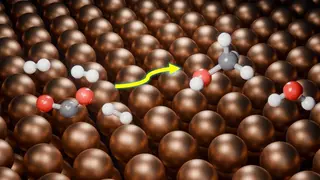
Researchers built a computational map of CO2 hydrogenation on copper that included thousands of reactions often left out of smaller models. The expanded network predicted far greater conversion and matched experiments better, identifying methanol and carbon monoxide as key products. The work suggests that previously ignored hydrogen-transfer steps can shape how carbon dioxide is turned into fuels and chemicals.
Researchers at the Indian Institute of Science created a computational framework for carbon dioxide hydrogenation over copper. It grew from a verified set of 152 reactions to 9,389 elementary steps involving 105 surface species. Machine learning estimated activation barriers, while automated tools identified single-step transformations.
The smaller network mispredicted formic acid as the main product and underestimated conversion. The larger one forecast about forty times as much CO2 conversion and matched experiments, pointing to methanol and carbon monoxide. It also revealed hydrogen can move directly from molecular H2 to intermediates, a route confirmed by further quantum calculations.
Better models may help chemical producers, engineers, and researchers design CO2 conversion processes with fewer overlooked steps. If such predictions translate to industry, fuels and chemicals production could become more efficient or selective, potentially affecting energy and manufacturing sectors. Policymakers and investors may use improved projections, but actual societal benefits depend on scale, cost, and deployment.