Outer Space Treaty Entered Force on October 10, 1967
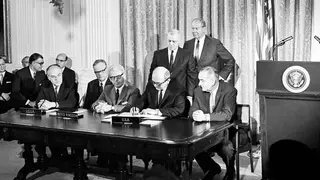
On October 10, 1967, the Outer Space Treaty entered into force after ratification documents were deposited with the United States, the United Kingdom, and the Soviet Union. The agreement emerged after a decade of superpower space competition and established principles for peaceful use of outer space, with 84 nations initially supporting it. It has never been amended and remains central to modern disputes over commercial satellite constellations and antisatellite debris.
The treaty's path began with Eisenhower's 1958 letters to Soviet leaders and his 1960 UN proposal to extend Antarctic Treaty principles — freezing territorial claims, banning military bases — to the Moon and planets. Nothing binding followed immediately.
Two orbital episodes shifted opinion: the 1962 Starfish Prime detonation, whose artificial radiation belt damaged satellites including Telstar 1, and the 1963 Project West Ford copper dipole release, which drew worldwide astronomical protest and shaped Article IX's consultation clause.
The treaty's unamended text may continue to shape how governments, satellite operators, and astronomers navigate orbital congestion. Because it was drafted when only states launched spacecraft, its provisions could be stretched to address commercial constellations and debris-generating weapons tests, leaving regulators to interpret 1966 language. People relying on satellite broadband, navigation, and weather data may feel those decisions indirectly, as could future crews and industries whose access to orbit depends on how these disputes are settled.