Webb Telescope Image Shows Gravitational Lensing in Galaxy Cluster
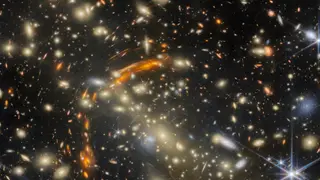
A James Webb Space Telescope image released Sept. 29, 2026, shows galaxies in the cluster MACS J0454.1-0300 warped and multiplied by gravitational lensing. The orange galaxies on one side are actually more distant objects whose light has been bent and magnified by the cluster's mass. The effect creates a visual pattern similar to a house of mirrors.
The Webb image, released Sept. 29, 2026, centers on MACS J0454.1-0300. Its golden members form the cluster itself. The orange grouping to one side belongs to a more distant population; the cluster's gravity alters their apparent shape and brightness.
The foreground mass therefore acts as a natural lens, making background sources appear brighter and distorted. This produces stretched, repeated-looking forms reminiscent of mirrors. The image credits ESA/Webb, NASA, CSA, L. Furtak, and S. Fujimoto.
Images like this may deepen public interest in astronomy and space science, potentially influencing students, educators, and museum audiences. They could also support science communication and inspire future researchers or engineers. For broader society, such releases may shape how people understand the universe and humanity's place, though direct daily effects are likely limited.