X-Ray Imaging Reveals Famous Fossil Was an Aquatic Animal, Not an Early Land Dweller
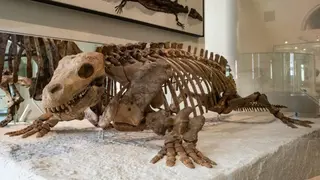
A 345-million-year-old Scottish fossil known as Westlothiana lizziae, or Lizzie, was long interpreted as an early amniote because its limbs ended in five-digit feet with claw-like tips. Using X-ray imaging at the European Synchrotron Radiation Facility, researchers from the American Museum of Natural History and the University of Oxford reconstructed hidden anatomy, including a primitive skull, ossified internal gills, and a fish-like mouth with thousands of tiny teeth. Published in Nature, the findings indicate Lizzie belonged to an older aquatic lineage and challenge its role as a key reference for the timing of land-adapted vertebrates.
Westlothiana lizziae, nicknamed Lizzie, was found in Scotland in 1984 and formally named in 1990. Its skeleton was preserved flattened across two rock slabs, leaving many internal features inaccessible until researchers used synchrotron X-rays in Grenoble. The team included scientists from the American Museum of Natural History and the University of Oxford, and published its findings in Nature.
The scans exposed an archaic skull, gills inside the head that had mineralized, and a mouth resembling a fish’s, with thousands of small teeth. These traits point to an aquatic or amphibious animal from an older tetrapod lineage, not a fully terrestrial amniote. Its five-toed, claw-tipped limbs show such features existed before land adaptation was complete.
This finding could reshape how museums, educators, and paleontologists present early vertebrate evolution, since a long-used reference fossil may need a new label and revised timeline. Students and general audiences may encounter a more complex story about when land-adapted traits appeared. Researchers relying on Westlothiana for evolutionary dating may need to reassess assumptions, while synchrotron imaging’s role in revealing hidden anatomy may gain wider attention.