Direct-to-Cell Starlink Maintains Low Orbit Despite Drag
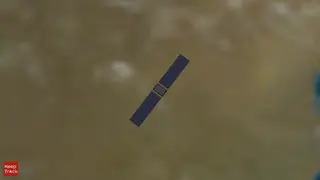
STARLINK-11444 is a Direct to Cell satellite orbiting at roughly 362 km, lower than most broadband Starlinks. Over 124 element sets spanning about 88 days, its semi-major axis varied by only about 1.5 km despite significant atmospheric drag. The satellite launched on a Falcon 9 in December 2024 and remains operational.
STARLINK-11444 is a Direct-to-Cell craft, meaning its payload can serve as an orbiting cell tower for ordinary handsets. It launched Dec. 23, 2024, from Kennedy Space Center’s LC-39A aboard a Falcon 9, catalogued as NORAD 62409 and 2024-249A. Built on SpaceX’s V2 Mini bus, it has a 0.3 m-thick, 4.1 m-wide body, 29 m solar arrays, and 730 kg launch mass.
Across 124 tracking records over 87.9 days, its semi-major axis stayed within roughly 1.5 km, ending 0.43 km lower. Its inclination barely shifted, and eccentricity remained small. Photometry found mean magnitude 7.31, with no rotation period, consistent with active attitude control.
If such satellites maintain low orbits reliably, they could help ordinary phones connect in places lacking terrestrial towers, potentially benefiting rural residents, travelers, and emergency responders. However, lower-altitude operations may require frequent station-keeping and could raise concerns about orbital congestion and astronomy. The actual societal effect may depend on service availability, regulation, and competition.