Rocket Lab's Path to Becoming a Tier-1 Space Power
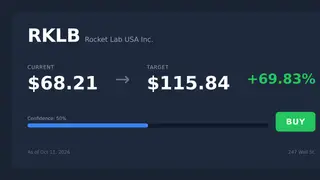
Rocket Lab CEO Peter Beck wants the company to become a self-launching tier-1 space power, and shareholders approved its Iridium Communications acquisition in September. The stock trades near $68 despite record second-quarter revenue growth of 62% and a $2.36 billion backlog that rose 137% year over year. Analysts see a $106.57 average target, while reaching $125 in 2027 depends on the reusable Neutron rocket competing with Falcon 9 at a $50 million to $55 million price.
Rocket Lab's proposed Iridium purchase would add more than $870 million in yearly revenue, with completion targeted for mid-2027. The company also holds an $816 million Space Development Agency contract and a $397 million Flatellite award, while the FY2027 budget proposes $17.9 billion for Golden Dome.
Neutron, a reusable medium-lift vehicle, is priced at $50 million to $55 million and may fly each booster 10 to 20 times. Management expects launch costs to decline from about $130 million toward $50 million as volume grows. Rocket Lab's non-GAAP gross margin improved to 41.5%, and its adjusted EBITDA loss narrowed to $8.8 million.
Rocket Lab's progress could affect investors, satellite operators, and communities that depend on communications. If Neutron and Iridium integration succeed, more affordable launch options may broaden access to space-based connectivity and related services. Delays or failures could pressure shareholders and slow planned capabilities. The outcome may influence competition in launch markets, potentially lowering costs, while also concentrating influence among a few space firms.