HiRISE Image Shows Stickney Crater on Mars's Moon Phobos
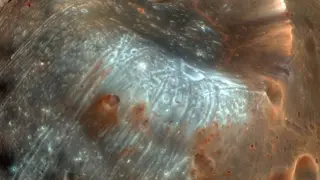
Stickney Crater is the largest crater on Phobos, the Martian moon discovered by Asaph Hall in 1877 along with Deimos. The crater spans more than 9 kilometers, nearly half of Phobos's diameter, and the impact that formed it may have almost shattered the small moon. A 2008 enhanced-color image from the Mars Reconnaissance Orbiter's HiRISE camera shows the crater and surrounding grooves, with bluish areas possibly indicating freshly exposed material.
Stickney is the biggest crater on Phobos, one of Mars's two moons. It honors Chloe Angeline Stickney Hall, a mathematician and the spouse of Asaph Hall, who found both Martian satellites in 1877. More than nine kilometers wide, the crater covers almost half of Phobos's diameter, and the collision that created it may have come close to breaking the small body apart.
The Mars Reconnaissance Orbiter's HiRISE instrument captured this color-enhanced view in March 2008 from roughly six thousand kilometers away. Although Phobos's gravity is extremely weak, trails inside the crater imply that loose debris moved down its walls. Bluish patches near the rim might mark recently uncovered material, while the surrounding grooves remain unexplained.
Detailed views of Phobos could deepen public and scientific interest in Mars's small moons, helping educators illustrate planetary impacts and weak-gravity geology. Researchers studying asteroid-like bodies may use such observations to refine models of crater formation and surface movement, which could inform future robotic missions. For broader audiences, the image may serve as a reminder of how space technology turns distant, little-known worlds into accessible subjects of study and wonder.