LISA mission to hunt gravitational waves with widely separated spacecraft
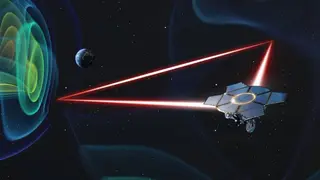
NASA and ESA are jointly developing LISA, a gravitational-wave observatory planned for launch in the mid-2030s. It will use three spacecraft arranged in a huge triangle, separated by about 1.6 million miles, with infrared lasers linking telescope pairs. By tracking tiny changes in free-floating test cubes, LISA aims to detect low-frequency gravitational waves that ground-based detectors cannot observe.
ESA will lead LISA, with NASA supplying telescopes, hardware, engineering, and science support. The observatory is planned for the mid-2030s and will place three spacecraft in a Sun-centered orbit that trails Earth. They will form an equilateral triangle, with each side about 1.6 million miles long.
Each craft will carry two telescopes and two small free-floating test cubes. Infrared lasers will link the telescopes, letting scientists measure distance shifts caused by passing gravitational waves. These changes are expected to be tinier than a helium atom's width. LISA targets low-frequency signals that Earth-based instruments cannot capture.
LISA could deepen understanding of black holes and gravity, affecting researchers in astrophysics and fundamental physics. Its precision laser technology may spill into other fields, such as navigation or aerospace. The public may gain new cosmic discoveries, while the long timeline means benefits would emerge gradually. International collaboration could strengthen scientific ties, though costs and priorities may draw scrutiny.