Overland AI promotes fully autonomous ground vehicles as advance over teleoperated UGVs
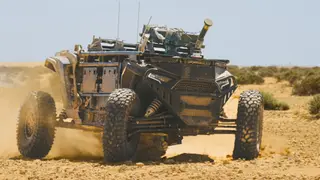
Overland AI is marketing fully autonomous ground vehicles that can navigate terrain and obstacles without a communications link, unlike remotely operated UGVs. The company says a single operator can direct a fleet using natural-language prompts, and it cites military exercises where two vehicles replaced 40 personnel and cut drop-zone distribution time by 52 percent. Under a $20 million APFIT agreement, Overland AI is working with the Marine Corps to field AGVs for the Marine Air Defense Integrated System.
Overland AI says its vehicles rely on onboard sensing and proprietary software to traverse rocks, thick brush, steep grades, and sudden ditches at tactically useful speeds, even when communications degrade or disappear. A single user can assign and coordinate many vehicles through natural-language instructions, without remote driving.
The company says field trials with service members informed the system. In one African joint exercise, Army officers estimated two vehicles did work otherwise requiring 40 people; another event saw drop-zone distribution time fall by 52 percent. Overland AI also says it became the first ground-autonomy firm to lead a U.S. military production contract, via a $20 million APFIT effort with the Marine Corps for MADIS.
If adopted more widely, autonomous ground vehicles could reduce the number of service members exposed to breaching, resupply, and counter-drone missions, potentially lowering some physical risks. Troops may shift toward supervising fleets rather than driving individual machines, changing training and staffing needs. Military leaders and contractors could face questions about reliability, accountability, and human control. The public may also encounter more autonomous systems in defense logistics, shaping debates over safety, oversight, and the future character of land warfare.