New Helium Survey Tightens Support for Standard Big Bang Model
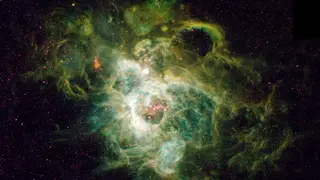
Astronomers studied metal-poor galaxies to isolate helium left over from the Big Bang, since later stellar fusion adds helium to the cosmos. Measurements of interstellar gas in 54 galaxies indicate that primordial helium makes up about 24.58% of cosmic matter by mass. This agrees closely with the Planck cosmic microwave background estimate of 24.67%, strengthening the standard Big Bang picture.
The Big Bang forged mostly hydrogen and helium, plus tiny amounts of light elements such as lithium. Heavier elements, grouped by astronomers as metals, arose later in stars, supernovae, and neutron-star collisions. Stellar fusion also creates helium, so researchers target metal-poor galaxies to limit that added helium.
The Large Binocular Telescope Primordial Helium Abundance Project measured interstellar gas in 54 galaxies. It found primordial helium at 24.58% of cosmic matter by mass, close to Planck's 24.67% cosmic microwave background estimate. The team further estimates about 90% of cosmic helium is primordial, with roughly 10% from stars.
This result may mainly affect cosmology research and science education, reinforcing confidence in the Big Bang framework. It could influence how textbooks, museums, and media explain cosmic origins. Astronomers may use the helium estimate to refine models of star formation and element production, indirectly shaping future astrophysics research priorities. The general public could encounter the finding as another independent check on established cosmology, though daily life is unlikely to change directly.