Saunders Sees No Good Path Forward for Trump on Iran
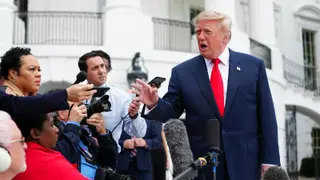
In a transcript of The New Republic's Right Now, political scientist Elizabeth Saunders argues that President Trump's Iran policy remains a choice between humiliation and escalation. She says escalation options have been drawn up and rejected, while the U.S. has sent another carrier, and notes the absence of a U.S. aircraft carrier in the Indo-Pacific. The discussion also covers a U.S.-Denmark-Greenland security agreement, Brazil's presidential election, and Secretary of State Marco Rubio's foreign policy address.
Elizabeth Saunders, a Columbia political scientist, tells The New Republic's Right Now that Trump's Iran options remain a choice between accepting a humiliating outcome and escalating militarily. She says reports indicate the Pentagon prepared escalation plans that Trump rejected, and that Washington has deployed another carrier.
Saunders also notes the U.S. currently lacks an aircraft carrier in the Indo-Pacific, calling that striking given long-standing U.S. interests there. She adds that Iranian proxy the Houthis have struck airports in Riyadh and Saudi Arabia, showing outside actors now shape the war's course.
This discussion could influence how voters, policymakers, and allies interpret U.S. credibility and restraint. Military families and consumers may feel consequences if Iran policy fuels higher oil prices or wider regional instability. Indo-Pacific partners might read the carrier gap as a signal about U.S. priorities. The segment may also shape media framing of Trump's choices, though its direct policy impact remains uncertain.