Podcast Explains Nobel-Winning Optogenetics, Neutrino Astronomy and Mirror Molecules
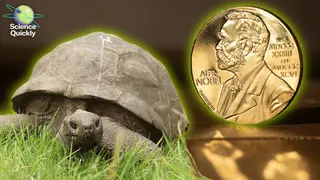
This podcast episode reviews the 2026 Nobel Prizes in Physiology or Medicine, Physics, and Chemistry. It explains optogenetics, which uses light to control genetically modified neurons, along with winning work on cosmic neutrino detection and mirror-image molecules. The episode also mentions a 194-year-old tortoise whose DNA may hold clues about aging.
This year’s medicine Nobel honored three researchers for work on light-sensitive ion channels and optogenetics. The approach genetically alters neurons so light can activate or silence them, offering more precise and less invasive control than electrodes. Two laureates traced the underlying mechanism to a light-following alga, while the third adapted it for experiments in mammals.
The physics prize went to Francis Halzen for detecting high-energy neutrinos from beyond Earth, work linked to Antarctic ice. Chemistry recognized mirror-image molecule research. Separately, a 194-year-old tortoise’s DNA may offer aging clues.
These discoveries could eventually affect patients and clinicians through more precise neuromodulation, while neutrino astronomy may expand how researchers study the