Newly Identified Ancient Crocodile Shares Rock Layer With the Great Sphinx
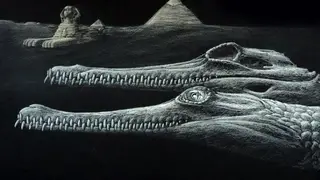
Fossils found in Egypt in the 1920s and once assigned to the living false gharial have been reclassified as a distinct extinct crocodile, Herugavialis cairensis, after CT scanning of a nearly complete skull. The 45-million-year-old remains came from the Mokattam Formation, the same rock unit used for the Great Sphinx, and the skull lacks its snout tip. Researchers named the animal after the Egyptian god Heru, partly inspired by the Sphinx’s missing nose.
The Egyptian specimens were unearthed a century ago and long placed with today’s false gharial on the basis of similar long, narrow jaws. CT imaging of an almost whole skull revealed enough internal and structural differences to establish a separate extinct species, Herugavialis cairensis.
Its 45-million-year-old remains come from the Mokattam Formation, the rock unit also used for the Great Sphinx. The skull lacks its snout tip, and researchers chose the name Heru partly because the monument is missing its nose. These crocodiles lived in shallow seas; Mediterranean crocodile variety later collapsed as the region dried about six million years ago.
Discoveries like this may strengthen public interest in paleontology and Egypt’s deep past, potentially drawing more visitors to museums and science exhibits. Researchers could benefit from renewed attention to historical collections and CT-based methods, while educators may use the Sphinx connection to discuss extinction, climate, and biodiversity. The impact is likely modest and gradual, but it could broaden appreciation for how fossil evidence links iconic monuments, ancient seas, and modern conservation questions.