Pulse One Keyboard Turns Generative Design Into Shiny Metal Skeleton
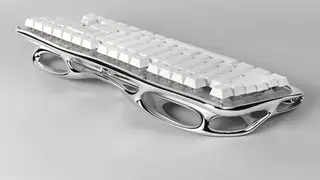
Pulse One is a wireless mechanical keyboard from Pulsekey, designed by Haoyuan Lu, Hongbin Zhang, and Wendi Yu. Its 3D metal-printed shell uses generative design and digital sculpting to merge the palm rest, frame, and bezel into a single reflective lattice. The board has white keycaps over clear switches and received a Silver award in the International Design Awards' computer accessories category.
Pulse One is a cordless mechanical keyboard by New York-based Pulsekey. Its creators, Haoyuan Lu, Hongbin Zhang, and Wendi Yu, used algorithmic form-finding plus digital modeling to produce a 3D-printed metal shell that joins wrist support, chassis, and front trim into one continuous, mirror-like structure. White caps sit above transparent switches.
The project won Silver in the International Design Awards’ computer accessories group. The article links its organic look to Joris Laarman’s 2006 Bone Chair and generative furniture, while noting the board is also hot-swappable, modular, and advertised to last weeks per charge.
This design may encourage peripheral makers to experiment with metal additive manufacturing and algorithmic shaping, potentially shifting some keyboards from utilitarian tools toward desk sculpture. Enthusiasts and industrial designers could benefit from more visible examples of generative methods, while mainstream buyers may see trickle-down styling or modular features. Because such production can remain costly, its broader accessibility could stay limited, keeping the most dramatic versions niche.