Jurassic mammal relative fossil shows early step toward nursing
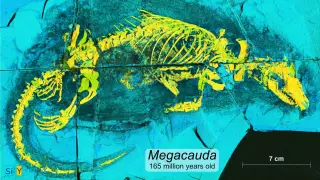
A 165-million-year-old fossil named Megacauda sungei describes a small but relatively large Jurassic mammal relative that swam and used backward-curving teeth to catch slippery prey. Researchers found evidence of a soft palate that separated the mouth from the pharynx, allowing it to swallow without losing the ability to breathe. This trait is considered an early step toward safe nursing in mammals and part of the evolutionary path leading to modern mammalian features.
Megacauda sungei measured about half a meter from nose to tail, making it unusually bulky beside most of its Jurassic kin. Short fur and a broad, flattened tail gave it an otter- or platypus-like profile, and CT-based reconstructions indicate it paddled with its front limbs while its tail moved in undulating waves, hind legs helping it steer. Backward-curving tooth cusps gripped slippery prey.
The team, based in Shenyang, Chicago, and Bonn, reported in Nature that the animal preserves evidence of a soft palate dividing the oral cavity from the pharynx — anatomy that lets an animal swallow and breathe simultaneously, and one linked to keeping milk out of the nasal passages during nursing.
Findings like this may sharpen how scientists trace the origins of mammalian feeding and breathing, giving paleontologists and evolutionary biologists a fresh anatomical benchmark to compare against other fossils. Museum exhibits and science coverage could carry the story to wider audiences, perhaps renewing public curiosity about Jurassic life. For most people the effect is likely indirect: a clearer sense of how traits underlying human swallowing, speech, and infant feeding took shape across deep time.