Montana Fossil Suggests Small Oviraptorosaur Had a Sliding Jaw for Soft Fruit
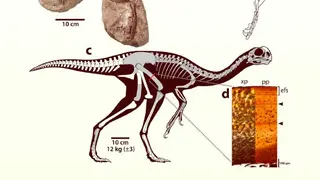
Fossils from Montana describe Infernogallus jamesi, a roughly 12-kg oviraptorosaur that lived during the latest Cretaceous. CT-based reconstructions indicate its jaw muscles mainly produced front-to-back motion, allowing the lower jaw to slide about 15 mm and suggesting a weak bite. The weak bite, interlocking jaw ridges, and absence of stomach stones point to a diet of soft, processed food such as fleshy fruit.
Infernogallus jamesi is known from a nearly complete articulated skull and partial skeleton found in Montana’s Hell Creek Formation in 2011. Additional fossils from Montana, South Dakota, and North Dakota have been assigned to the species. Bone sections indicate it was at least six years old and fully grown at about 12 kg.
CT reconstructions show jaw muscles chiefly drove front-to-back movement, letting the lower jaw slide roughly 15 mm. Ridges and grooves on upper and lower jaws interlocked during this motion. No stomach stones were found, and the weak bite suggests soft, processed food such as fleshy fruit.
This discovery may enrich museum exhibits and classroom discussions about dinosaur feeding, evolution, and ancient ecosystems. It could draw public interest to Montana’s fossil heritage and to how CT imaging helps paleontologists infer behavior from fragile remains. Researchers and science communicators may use it to illustrate links between dinosaur evolution and flowering plants, though its direct societal effects are likely modest and mainly cultural and educational.