Study: Sun's white-dwarf transition may destabilize outer planets sooner
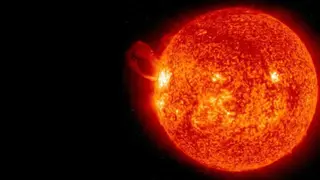
A new study proposes that the Sun's transition into a white dwarf may involve sudden, uneven mass ejections rather than a smooth outflow. Those random impulses could disrupt the orbits of Jupiter, Saturn, Uranus, and Neptune within roughly a billion years, far earlier than the previously estimated quintillion-year stability. Earth would likely be consumed by the Sun before that outer-planet chaos unfolds.
The study, published in The Astrophysical Journal Letters, involved Konstantin Batygin and Jim Fuller of Caltech and Fred Adams of Michigan. It contrasts the old picture—gradual solar mass loss leaving outer planets stable for about 10^18 years—with a model where the dying Sun sheds material in abrupt, uneven bursts. These bursts alter the Sun's position and gravitational pull.
Simulations tested 672 cases with different burst masses and followed them for 3 billion years. With larger ejections, roughly 90% of systems became unstable within 3 billion years after white-dwarf formation, and about 40% showed disruption before that stage. Jupiter, Saturn, Uranus, and Neptune might scatter, exchange orbits, or escape; Earth would likely be consumed earlier.
This story may mainly affect public imagination and science communication, since the timescales are billions of years and pose no near-term risk. Astronomers could use it to refine models of stellar evolution and planetary stability. Educators and media may present it as a reminder that even long-lived planetary systems can change. Space-science enthusiasts might follow follow-up simulations, but daily life and policy are unlikely to be directly affected.