Chemists Create Long-Predicted Porous Carbon Allotrope Called Diamondiyne
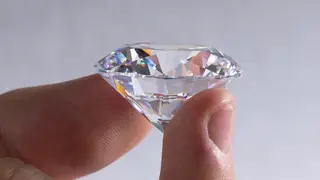
Researchers at the University of Gothenburg have created diamondiyne, a carbon allotrope first proposed 35 years ago, by linking carbon atoms through triple bonds into a three-dimensional tetrahedral network. Electron microscopy confirmed repeating crystal patterns in nanoscale patches on a thin film formed where two liquids meet. The porous, diamond-like material forms without high pressure and adds a new known arrangement to carbon’s structural family.
Diamondiyne was first proposed in theory 35 years ago. The Gothenburg team produced it within a film at the boundary between two liquids, using relatively low-cost apparatus. Its carbon atoms are linked by triple bonds into corner-connected tetrahedra, yielding a three-dimensional framework with empty spaces.
Electron microscopy at Stockholm University detected periodic crystalline order only in tiny surface patches, roughly 10 nanometers per side, consistent with theoretical models. The project grew from attempts to make covalent organic frameworks without metal ions, unlike metal-organic frameworks. Diamondiyne is the first three-dimensional example among recently created carbon allotropes.
If diamondiyne can be produced beyond nanoscale patches, materials researchers and industries that rely on porous