How Refillable and Disposable Vapes Differ in Hardware Design
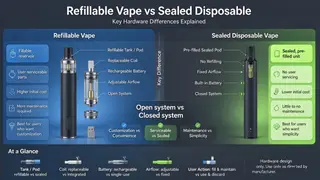
The article compares how refillable and sealed disposable vapes are built. Refillable devices have tanks or pods that users can open and refill, whereas sealed disposables come prefilled and are not designed for regular refilling. It also examines coil construction, maintenance, and resource consumption.
Refillable systems center on user-accessible liquid storage. Their tanks or pods include seals, stoppers, or fill ports that must block leaks while still permitting e-liquid to be added. This design also lets makers vary pod shape, capacity, and coil setup, and some pods or coil heads can be swapped when worn.
Sealed disposables take the opposite route: liquid is installed at the factory, the fill point is closed, and the shell is not meant to be opened routinely. Their coil, wick, airflow, resistance, and power are fixed together, so a spent heater can retire the whole unit even if charge or liquid remains.
The design split may affect consumers, waste systems, and retailers. Refillable users could spend more time maintaining devices, yet replaceable parts may reduce discarded hardware. Sealed-device users may value simplicity, but failed coils or batteries could create more single-use waste. Manufacturers and recyclers may face questions about serviceability and disposal. These outcomes are possibilities, not certainties.