Stellar Edges Dim in Nearby Star Survey
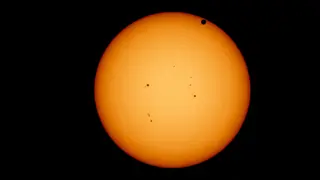
Astronomers used the CHARA Array to measure limb darkening in 31 nearby stars, confirming that their edges appear dimmer than their centers. The effect happens because light from a star's edge travels through more of its atmosphere, where more light is absorbed or scattered. These near-infrared observations could help researchers better understand the atmospheres of stars beyond the Sun.
Limb darkening was first recorded for the Sun by Pierre Bouguer in the 1700s. It arises because light leaving a star’s edge passes through a longer slant of atmosphere than light from the center, so more is absorbed or scattered. Directly measuring this effect on other stars is hard; only a few large stars and some transiting systems had provided data.
Using the CHARA Array, researchers examined 31 nearby stars at 1.6 and 2.2 microns. The longer wavelength showed weaker darkening, but the measured difference—about 38%—was larger than models predicted, roughly 20%. This suggests current stellar-atmosphere descriptions need refinement.
This result could influence how astronomers model stars, which may improve interpretations of exoplanet observations. It may also affect observatories and instrument teams that pursue similar high-resolution, near-infrared measurements. For the public, clearer stellar models could make astronomy coverage more accurate, though direct everyday effects are likely minimal.