Orbital Mechanics May Allow Many Planets to Share a Star’s Orbit
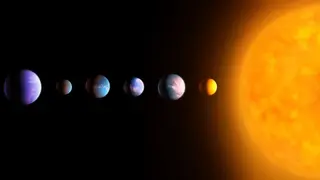
The article explores whether multiple planets can share the same orbit around a star, a scenario made possible by certain solutions in orbital mechanics. Although a counter-Earth hidden opposite our planet does not exist, stable configurations such as horseshoe orbits could in principle allow many planets to occupy similar paths. The piece explains how adding a third massive body complicates the mathematics of such systems.
The article notes that a hidden twin Earth on the opposite side of the Sun is not real. Its gravity would have detectable effects on Venus and Mars, and spacecraft exploring the solar system would have seen it. Yet orbital mechanics does permit planets to share a path under special conditions.
A horseshoe orbit arises when two worlds follow nearly identical tracks but at slightly different distances. Their gravity can exchange orbital energy without a collision, causing each to shift inward or outward and change speed. Introducing a third massive body makes the mathematics far harder, but stable solutions can still exist.
This story may mainly affect science enthusiasts, students, and educators by making orbital dynamics more accessible and showing how counterintuitive gravity can be. It could also influence how writers and game designers imagine planetary systems, and it may encourage public interest in astronomy and space missions. However, because no such planets are known in our solar system, its practical near-term effects on daily life are likely limited.