Amber Fossil Reveals Ancient Planthopper With Folded, Bendable Mouthparts
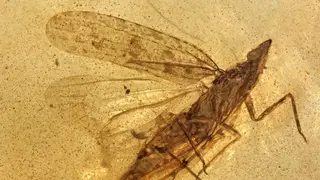
A 99-million-year-old planthopper trapped in Kachin amber had mouthparts nearly twice as long as its body. Researchers found the organ was covered in crosswise folds that likely allowed it to bend without kinking, similar to a flexible straw. They also saw no convincing evidence that the insect carried pollen or fed on nectar.
Researchers studied 13 Kachin amber specimens from Myanmar, including the new species Cretodorus noonoo. The insect belongs to Neazoniidae, an extinct planthopper family. Its mouthparts were nearly twice its body length and pointed backward, unlike butterfly proboscises used for nectar.
High-resolution micro-computed tomography showed crosswise folds formed part of the organ's structure. Some fossils preserved bent mouthparts, suggesting flexibility in life. The team proposes the insects fed on tree sap, using grooved tip lobes to anchor within bark cracks. This folded design is absent in living relatives.
This discovery may mainly affect researchers and science communicators, offering a vivid example of extinct biomechanics and evolutionary loss. Museum visitors and students could encounter it as a case of convergent engineering, comparing insect mouthparts with flexible straws. It may also modestly inform discussions of how ancient forests and fire-prone, thick-barked trees shaped feeding strategies. Any practical applications remain speculative.