New Computational Framework Tracks Energy Loss in Crystal Qubit Defects
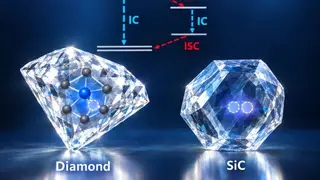
Researchers at the University of Chicago built a computational method that models the complete optical cycle of spin defects in crystals, including a difficult-to-predict vibrational energy-loss process called internal conversion. For a divacancy in silicon carbide, including this process corrected a long-standing mismatch between theoretical predictions and experiments by showing it strongly affects the lifetime of the triplet excited state. The work could help improve crystal defects used as qubits and quantum sensors.
Researchers at UChicago PME’s Galli Group created a computational approach to model how spin defects in crystals absorb laser energy and later release it. The method includes internal conversion, where energy dissipates into vibrations of nearby atoms.
For a silicon carbide divacancy, adding this vibrational pathway helped reconcile theory with experiments by altering the predicted lifetime of the triplet excited state. In diamond’s nitrogen-vacancy center, the framework matched spectroscopy data, with internal conversion mattering little for triplet states but dominating singlet-state energy loss.
Improved modeling of crystal defects could help researchers develop more dependable qubits and quantum sensors. Academic and industrial quantum-technology teams may benefit from faster, less costly design cycles, while eventual users of quantum sensors could gain from more precise measurement tools. Because the work is computational and early-stage, broader societal effects remain uncertain and may take years to emerge.