JWST Observes Weather Patterns on a Cold Brown Dwarf
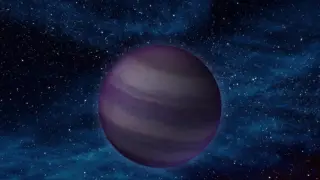
Astronomers used JWST to study WISE 0855, the coldest known brown dwarf, which lies about 7.2 light-years away. The observations reveal water-ice clouds and changing atmospheric conditions in this object, which is too massive to be a planet but never sustained core fusion. The work helps characterize weather and atmospheric physics in a temperature range unlike any in our solar system.
Brown dwarfs occupy a mass range between planets and stars: they arise from collapsing material but never ignite sustained core fusion, and none are known in our solar system. WISE 0855, found in 2014, is the third-closest system to ours, about 7.2 light-years away in Hydra, and the coldest known brown dwarf, with upper-atmosphere temperatures near 265 K.
It is roughly Jupiter-sized but 3–10 times more massive, and its infrared glow lets astronomers track it. JWST’s NIRSpec recorded 44 spectra over 11 hours, each every 15 minutes from 2.87 to 5.27 microns, to test whether water clouds or disequilibrium chemistry explains its signals.
This result could sharpen atmospheric models used for brown dwarfs and exoplanets, giving researchers a better benchmark for cloud formation and chemistry at very cold temperatures. It may also influence how scarce telescope time is allocated and how science communicators explain objects between planets and stars. Public audiences and students could gain a clearer sense of how JWST tests competing explanations, though the immediate everyday effects are likely indirect and modest.