Precise helium measurement probes conditions after the Big Bang
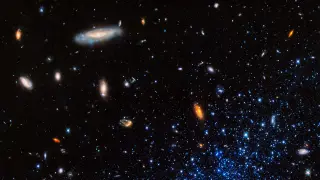
An international team used 130 hours of observations from the Large Binocular Telescope to study helium in 15 very pristine distant galaxies. They reduced the uncertainty in the primordial helium abundance to 0.5%, three times better than earlier estimates. The result gives cosmologists a sharper test of Big Bang conditions and the Standard Model of particle physics.
The project involved researchers from the University of Minnesota Twin Cities and appeared in five Astrophysical Journal papers. Observations totaled 130 hours on the Large Binocular Telescope, targeting 15 small, distant galaxies whose chemistry has changed little since early times.
By examining more than ten helium spectral lines and fifteen hydrogen lines with Ohio State–developed spectrographs, the team lowered primordial helium uncertainty to 0.5 percent—three times tighter than prior estimates. This measurement helps constrain conditions in the universe’s first five minutes and offers a sharper check on the Standard Model.
The result may matter most to cosmologists and particle physicists, who could use the tighter helium figure to test models of the early universe. Because such precision work often feeds long-term instrument and computing development, it could indirectly affect broader scientific research and education. General audiences may see few immediate daily changes, but the finding could shape how science communicators explain evidence for the Big Bang and the limits of the Standard Model.