Hubble Lensing Survey Prepares Roman Space Telescope Science
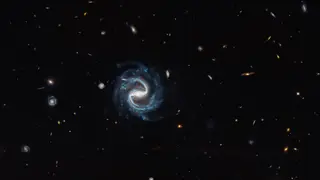
Hubble captured a gravitational lens alongside a barred spiral galaxy, one of many lensing images gathered ahead of Roman’s science operations. The lens is formed by a foreground elliptical galaxy about 4.5 billion light-years away magnifying a more distant background galaxy. Such observations help researchers prepare for the Nancy Grace Roman Space Telescope’s work.
Hubble’s image places a barred spiral near the center, while a lens sits in the lower-right corner. The lens is produced by a foreground elliptical galaxy roughly 4.5 billion light-years away; its gravity bends and brightens light from a background galaxy about 8 billion light-years distant.
That farther galaxy appears twice: a prominent arc above-left of the foreground galaxy and a smaller, reversed arc below-right. Astronomers use such distortions to estimate the foreground galaxy’s mass, including unseen dark matter. This image belongs to a set Hubble gathered to help plan Roman Space Telescope observations.
The preparation could benefit astronomers by testing methods for measuring galaxy mass and dark matter before Roman begins. It may also help mission planners and science communicators anticipate how future lensing data will be used. Public audiences could gain clearer examples of how chance alignments reveal invisible mass, though the immediate effect is likely limited to the research and education communities.