Rosetta Captures a Comet-Side Self-Portrait
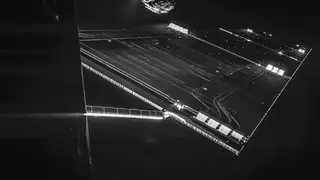
The image shows Rosetta on Oct. 7, 2014, when the comet-bound craft was roughly 16 kilometers from the surface of 67P/Churyumov-Gerasimenko and about 472 million kilometers from Earth. It was assembled from two exposures by the CIVA camera on the still-attached Philae lander, capturing sunlight on a solar array plus dust and gas leaving the comet's two-lobed nucleus. Philae took this final camera image before separating from Rosetta on Nov. 12.
On October 7, 2014, Rosetta was about 472 million kilometers from Earth and 16 kilometers from comet 67P/Churyumov-Gerasimenko. The portrait combined a short and a long exposure from the CIVA camera on Philae, which was still attached to the orbiter. Sunlight reflected from a 14-meter solar array, while dust and gas rose from the comet’s two-lobed nucleus.
The chosen primary landing site lay on the visible part of the smaller lobe. This was Philae’s final camera image before it separated from Rosetta on November 12; soon afterward it looked back at the orbiter while beginning its descent.
The release of this image could strengthen public interest in planetary science and space exploration, especially among students, educators, and amateur astronomers. It may also help mission teams and science communicators explain complex operations—camera timing, lander separation, and comet activity—to broader audiences. Because the image is historical rather than new data, its near-term impact may be mainly educational and cultural, reinforcing public familiarity with Rosetta and Philae.