Hidden mathematical symmetry boosts stability of quantum skyrmions
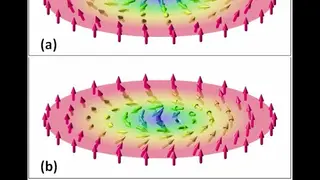
Scientists have discovered that a specific mathematical property grants quantum skyrmions—topological spin structures—an unexpected resilience against disruption. This stability could significantly enhance the performance of future quantum computing systems. The finding opens new pathways for designing robust quantum materials.
Scientists have uncovered that a previously unrecognized mathematical symmetry underpins the stability of quantum skyrmions—nanoscale spin textures with topological protection. This hidden property enables these structures to resist external disturbances such as thermal fluctuations and magnetic noise, which typically degrade delicate quantum states. While the exact nature of the symmetry remains unspecified in the available material, its presence is identified as a key factor in enhancing resilience without requiring additional physical shielding or extreme environmental conditions. The discovery emerged from theoretical modeling and simulations, though experimental validation has not yet been detailed in the summary.
The finding builds on decades of research into topological materials and their potential for quantum information processing. Prior work has shown that skyrmions—first observed in magnetic materials—can serve as stable carriers of information due to their robustness against local perturbations. However, achieving consistent stability at operational temperatures and scales remained a challenge. This new insight suggests that mathematical structure alone may be sufficient to confer resilience, potentially simplifying the design of next-generation quantum devices.
The research is likely conducted by theoretical physicists or materials scientists working in quantum condensed matter physics, though no specific institutions or individuals are named. The broader
This discovery could influence the trajectory of quantum technology development by offering a new route to stability without relying on cryogenic cooling or complex error correction schemes. If scalable, such materials might reduce the cost and complexity of quantum hardware, making it more accessible to industries like cryptography, drug discovery, and financial modeling. The impact may ripple through semiconductor manufacturing and data center infrastructure, where reliability is paramount. A comparable precedent is the development of topological insulators in the early 2000s—initially theoretical but later shown to host robust surface states, leading to new classes of electronic devices. Similarly, this symmetry-based stability could become foundational for a new generation of quantum materials. What to watch for includes whether experimental groups can replicate the predicted behavior and whether industry partners begin investing in skyrmion-based prototypes. The long-term so