Ultrasound-Powered Invisible Channel Moves Liquids Mid-Air Without Physical Contact
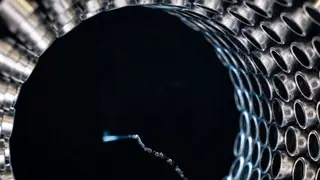
Scientists at the University of Helsinki have developed a method to guide liquid streams through open air using only focused ultrasonic waves, forming a virtual pipe with no physical structure. The technique enables precise, contactless transport of fluids, potentially revolutionizing lab-on-a-chip systems and contamination-free handling in pharmaceuticals. This innovation mimics a frictionless conduit, offering new possibilities in microfluidics.
Scientists at the University of Helsinki have demonstrated a novel method for manipulating liquid streams through open air using precisely focused ultrasonic waves. This technique creates an invisible, contactless channel—effectively a virtual pipe—that guides fluids without any physical conduit. The system relies on acoustic radiation forces generated by high-frequency sound waves to suspend and direct droplets or continuous liquid flows mid-air, enabling frictionless transport. While specific details such as frequency ranges, fluid types tested, or distance limitations are not provided in the summary, the core innovation lies in achieving controlled movement of liquids without surface contact, a significant advancement in microfluidic engineering.
This development builds on decades of research into acoustic levitation and manipulation, particularly in the context of non-contact handling for sensitive materials. Prior work has shown ultrasonic waves can suspend small particles or droplets, but directing continuous streams through air with precision represents a leap forward. The University of Helsinki’s approach may stem from earlier studies in acoustofluidics, where sound is used to control fluid dynamics at microscale levels. By refining wave focusing and control algorithms, researchers have now achieved directional transport—potentially enabling new forms of lab-on-a-chip devices that avoid contamination risks inherent in physical channels.
The primary actors are the re
This breakthrough could reshape how delicate fluids are handled in sensitive environments, particularly in pharmaceuticals and diagnostics where contamination must be avoided. By eliminating physical channels, the method may reduce cross-contamination risks, simplify cleaning protocols, and enable new designs for portable diagnostic devices. Industries reliant on microfluidics—such as point-of-care testing or personalized medicine—may see accelerated innovation if this technology proves scalable and cost-effective. A comparable precedent is the development of digital microfluidics, where droplets are manipulated using electric fields; however, that approach still requires electrode surfaces. Ultrasound-based transport offers a truly contactless alternative, potentially avoiding surface interactions altogether. If proven reliable, it could disrupt existing microfluidic platforms, prompting re-evaluation of current hardware standards and supply chains. The next phase may involve testin