Hidden Salt Reservoirs May Be Lurking Beneath Ceres’ Icy Surface
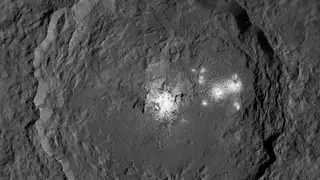
A new study suggests that water ice on Ceres may be concealing far greater amounts of surface salts than previously believed. Researchers used data from NASA’s Dawn mission and computer modeling to show that salt deposits likely formed through the sublimation of ice, with their true extent underestimated in earlier observations. The findings imply that Ceres’ surface chemistry is more complex and active than once thought, offering clues to its icy past and internal evolution.
New research led by scientists at Caltech has revealed that salt deposits on Ceres may be significantly more abundant than previously estimated—potentially 30 to 50 percent greater—due to a process where water ice sublimates and leaves behind concentrated salts. The findings, published in the Journal of Geophysical Research: Planets in October 2026, are based on reanalysis of data from NASA’s Dawn mission (2015–2018), which observed bright spots in craters like Occator. These spots were long thought to be surface salt deposits, but the new study suggests that much of the salt may be hidden beneath layers of ice, only becoming visible when surface ice is exposed through landslides or mass wasting events. The researchers developed computer models showing that salt-rich ices sublimate more readily than pure ice, creating a feedback loop where warmer regions lose ice faster, leaving behind saltier residues. This process explains how salt concentrations increase over time without requiring initial high salt content.
The work builds on earlier observations from Dawn and addresses a long-standing paradox: if water ice has a geologically short lifetime on Ceres’ surface, how do salt-rich deposits persist? The study resolves this by proposing that surface ice is continually replenished through subsurface migration or landslides, allowing salt to concentrate at the visible surface over time. This dynamic process—akin to thermal segregation seen on icy moons—suggests a more active and
This discovery could reshape how planetary scientists interpret surface features on icy bodies beyond Ceres, particularly in the asteroid belt and Kuiper Belt. If salt concentration through sublimation is a widespread process, it may alter models of surface evolution for other small solar system bodies like Pluto’s moons or distant dwarf planets. The findings may also influence mission planning, as future probes could prioritize sites with dynamic surface activity where subsurface materials are exposed. In the broader context, this mirrors how early assumptions about Mars’ dryness were overturned by evidence of ancient water flows—demonstrating that initial interpretations based on limited data can be misleading. Just as Viking-era Mars missions underestimated water’s role, Dawn’s earlier salt assessments may have missed a key process in planetary evolution. The implications for astrobiology are indirect but notable: active surface chemistry suggests ongoing internal processes, which c