Viking 2’s Long-Lost Marsquake Signals Revisited by Modern Data
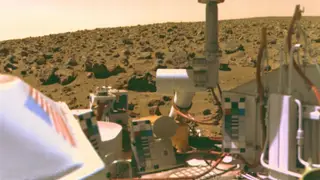
A reanalysis of data from NASA’s 1976 Viking 2 mission reveals that two previously unconfirmed seismic events likely originated in the same region where NASA’s InSight lander detected nearly 1,000 marsquakes decades later. This suggests Mars has long-term seismic activity in certain areas, challenging earlier assumptions about the instrument's limitations.
In 1976, NASA’s Viking 2 lander touched down in Utopia Planitia on Mars, carrying a seismometer intended to detect marsquakes. It recorded two potential seismic events on sols 53 and 80 of its mission—approximately two months after landing—but the data was inconclusive due to interference from wind vibrations. Decades later, NASA’s InSight lander, which arrived in Elysium Planitia in November 2018, detected nearly 1,000 marsquakes over four years, providing a much clearer picture of Mars’s seismic activity. A new study led by Wanbo Xiao at Peking University reanalyzed the Viking 2 data using InSight’s findings as context. The research suggests that the sol 80 event likely originated in the same general region—northern plains near Utopia Planitia—as several of InSight’s seasonal marsquakes, though it remains uncertain whether it was a tectonic quake or a meteorite impact. The study, published in AGU Advances on September 30, 2026, highlights how modern data can reframe historical observations. While Viking 2’s instrument was limited by design and environmental noise, InSight’s ground-based seismometer offered unprecedented sensitivity. This comparison reveals that certain regions of Mars may experience long-term seismic activity, challenging earlier assumptions about the planet’s geological dormancy.
The broader scientific community has long debated whether Mars is still tectonically active. Viking 2’s ambiguous results were dismissed by many in favor of later data from InSig
The reanalysis of Viking 2’s data could influence public perception of Mars as a dynamic world, reinforcing the idea that planetary science benefits from long-term data preservation. While not immediately altering policy or funding, it may inspire greater investment in archival research and cross-mission data integration. Institutions managing space mission archives—such as NASA’s Planetary Data System—may gain renewed attention for their role in enabling such breakthroughs. This echoes the 1990s reanalysis of Voyager data that revealed new insights into Jupiter’s atmosphere, showing how old missions can yield new science decades later. The story may also affect educational outreach, offering a compelling narrative about scientific persistence and the value of revisiting historical records. In the broader context, it could encourage private space ventures to prioritize long-term data retention alongside mission execution. What to watch for next is whether similar reanalyses of other ea