Ancient Martian Meteorite Unveils Secrets of the Red Planet’s Early Crust
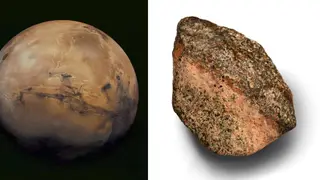
A 4.1-billion-year-old rose-colored meteorite named Teghaza 001, discovered in Mali's Sahara Desert, is providing unprecedented insights into Mars' ancient crust and early water-rock interactions. Scientists have dubbed it a 'Rosetta Stone for Mars' due to its unique composition and age, offering a rare glimpse into the planet’s formative period. The findings come from recent studies published in Science Advances and Science, enhancing our understanding of Martian geology.
Teghaza 001, a rose-colored meteorite weighing 800 grams, was discovered in 2022 in Mali’s Sahara Desert and has been identified as one of the oldest known Martian rocks, dating back approximately 4.1 billion years. It is now among the 435 meteorites confirmed to originate from Mars. Two recent studies—one published in Science Advances in June and another in Science in October—have revealed its unique composition: a mix of igneous minerals not seen in earlier ancient Martian meteorites like ALH84001 or the younger "Black Beauty." The presence of zircon crystals, which serve as precise geological clocks, helped confirm its age and indicate that it underwent water-rock interactions around 4.1 billion years ago—suggesting an early and dynamic water cycle on Mars. Scientists at NASA’s Jet Propulsion Laboratory (JPL), including lead author Yang Liu, and researchers from Caltech and NASA’s Ames Research Center, such as Lee Saper, have used advanced dating techniques to analyze the rock’s texture and chemistry. While its exact origin on Mars remains unknown, 13 potential sites in the southern highlands match its mineral signature. The meteorite is being hailed as a "Rosetta Stone for Mars" due to its unprecedented insight into the planet’s early crust formation and atmospheric evolution during its formative era.
The significance of Teghaza 001 lies in its ability to fill a critical gap in our understanding of Martian geology—specifically, how igneous processes shaped the planet’s c
Teghaza 001’s discovery could reshape public and scientific perceptions of Mars as a planet with a complex, early history of geologic and hydrologic activity. For planetary scientists, it offers a rare terrestrial proxy for studying Martian crust formation without launching expensive missions. This may accelerate interest in sample-return missions and influence funding priorities at agencies like NASA and ESA. The meteorite’s role as a "Rosetta Stone" suggests it could become a benchmark for interpreting data from Mars rovers and orbiters, potentially refining models of planetary evolution. Comparable to how the discovery of lunar samples during the Apollo program revolutionized our understanding of the Moon’s origin, Teghaza 001 may serve as a foundational reference point for Martian science. Its analysis could also impact private space ventures focused on Mars exploration by providing clearer geological targets. Looking ahead, researchers may use similar dating techniques to analyze