Ancient Martian Rock Discovered in Sahara Dates Back to Planet's Earliest Era
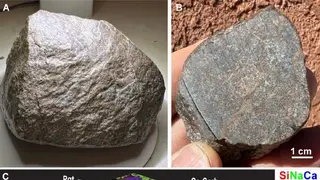
A meteorite named Teghaza 001, found in Mali’s Sahara Desert, has been identified as a fragment of Mars’ primordial crust formed at least 4.1 billion years ago, making it the oldest known igneous rock from the Red Planet. Analysis of zircon and rubidium-strontium isotopes confirms its age and suggests it cooled slowly underground, possibly in a watery environment shortly after formation. The discovery offers unprecedented insight into Mars’ early geologic history and hydrological activity during its first billion years.
In October 2026, scientists announced the discovery of Teghaza 001, a Martian meteorite found in Mali’s Sahara Desert in 2022, which has been confirmed as the oldest known igneous rock from Mars—formed at least 4.1 billion years ago. The meteorite consists of eight fragments totaling 798.5 grams, with the largest measuring 442 grams and 10 cm across. Analysis using uranium-lead dating on zircon crystals yielded an age of approximately 4.11 billion years, while rubidium-strontium isotope analysis suggested a slightly older date of about 4.24 billion years. The rock’s coarse-grained structure indicates it cooled slowly underground, likely in a watery environment shortly after formation. Unlike most Martian meteorites—primarily shergottites, nakhlites, and chassignites formed after 2.4 billion years—Teghaza 001 is a plagioclase-rich gabbro, representing a distinct, unaltered igneous type from Mars’ earliest era. Its oxygen isotopes are enriched in oxygen-18, pointing to interaction with water-rich fluids, and mineral alteration predates its ejection from Mars, likely due to hydrothermal activity. Researchers, including Dr. Yang Liu of NASA’s Jet Propulsion Laboratory and Dr. Carl Agee of the University of New Mexico, believe it originated in the southern Martian highlands northwest of the Hellas impact basin. The discovery is unprecedented because it offers a direct sample of Mars’ primordial crust and mantle during its first billion years, a period previously poorly understood
The discovery of Teghaza 001 could significantly influence planetary science and space policy by reinforcing the value of meteorite collections as sources of extraterrestrial data. While space agencies like NASA and ESA focus on robotic missions to Mars, this find demonstrates that Earth-based meteorites can provide critical insights into early planetary processes—potentially reducing reliance on costly sample-return missions in the short term. The scientific community may prioritize re-examining existing meteorite collections for similarly ancient specimens, especially from desert regions where preservation is optimal. This could lead to renewed interest in international collaboration for meteorite recovery and analysis, particularly in Africa and other arid zones. Secondarily, the finding may affect public perception of Mars as a geologically active world even in its earliest stages, potentially fueling broader interest in space exploration and astrobiology. It also echoes the impac