Comet-Borne Life Seeds: New Study Questions Ancient Theory
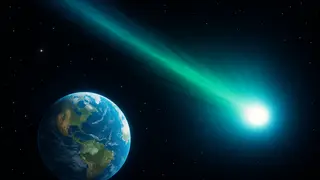
A University of Cambridge study challenges the long-held belief that comets delivered life's building blocks to early Earth. The research suggests such events were likely rare and isolated, not part of a continuous delivery process. This undermines the idea of comets as consistent sources of prebiotic molecules.
A new study led by Richard Anslow of the University of Cambridge, published in Scientific Reports on October 28, 2026, challenges the century-old hypothesis that comets delivered life’s building blocks to early Earth. The research uses advanced computer modeling of comet-atmosphere interactions and orbital dynamics to argue that such delivery events were likely rare and isolated, not part of a continuous process as previously assumed. The study finds that comets typically approach Earth at high velocities and steep angles, causing organic molecules—fragile compounds essential for life—to vaporize during atmospheric entry. Even if impact survival were possible, the quantity of molecules delivered would be insufficient to significantly influence prebiotic chemistry. The researchers also examined the possibility of comets “bouncing” between planets in a tightly packed system, as suggested by earlier EarthSky reports from 2023, but concluded this scenario was unlikely in our solar system due to insufficient planetary proximity and gravitational interactions. Despite the presence of key molecules like hydrogen cyanide (HCN) in comets, the study suggests these would not have survived or accumulated in sufficient quantities to seed life on Earth or Mars.
The broader scientific context includes decades of research into panspermia and the origin of life, where comets were seen as potential carriers of organic material. This idea gained traction after the discovery of complex molecule
This study could reshape public and scientific perceptions of how life began, potentially shifting focus from comets to other sources like meteorites or interstellar dust. If comets were not effective delivery vehicles, it may prompt renewed interest in terrestrial processes—such as hydrothermal vents—or in the role of planetary chemistry in generating prebiotic compounds. The findings may influence space mission planning, with future probes prioritizing asteroids or icy moons over comets for astrobiology targets. Institutions like NASA and ESA might revise their educational materials and outreach campaigns to reflect this evolving narrative. A comparable precedent is the shift in understanding about Mars’ habitability after data from rovers showed no evidence of past life despite early optimism. What’s next could include more detailed modeling of impact survivability, or new missions designed to test alternative delivery mechanisms. The scientific community may also reassess the role