New Study Challenges Long-Held Theory on How the Early Universe Lit Up
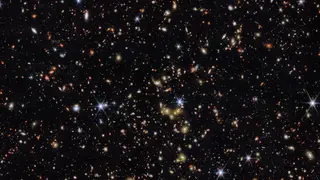
A recent study suggests that the transition from the universe's dark, hydrogen-filled infancy to a luminous cosmos may not have been driven by the first stars as previously believed. Instead, alternative mechanisms such as early black hole activity or diffuse radiation could have played a more significant role. The findings prompt a reevaluation of models explaining the end of the Cosmic Dark Age.
A new study has cast doubt on the long-standing belief that the first stars were primarily responsible for ending the Cosmic Dark Age—the period when the universe was filled with neutral hydrogen and devoid of light. Instead, the research proposes that other mechanisms, such as early black hole activity or diffuse radiation from unknown sources, may have played a more substantial role in ionizing the intergalactic medium and illuminating the cosmos. While the study does not specify exact timelines or locations for these alternative processes, it challenges the foundational assumption that star formation alone triggered reionization. This shift could necessitate a major revision of current cosmological models that have relied on stellar-driven reionization as a key pillar.
The background to this development lies in decades of theoretical work and observational efforts, including data from instruments like the Hubble Space Telescope and the James Webb Space Telescope, which have helped map early galaxy formation. Prior models assumed that the first stars—massive, short-lived Population III stars—emitted enough ultraviolet radiation to ionize surrounding hydrogen. However, recent findings suggest these stars may not have formed as abundantly or efficiently as once thought, leaving a gap in the explanation for how reionization occurred so rapidly after the Big Bang.
The study’s authors, though unnamed in the provided material, represent a growing cohort of astrophysicists seeki
This study could reshape how scientists interpret the universe’s early evolution, potentially affecting educational curricula, public understanding of cosmology, and funding priorities for space missions. If early black holes or diffuse radiation prove more influential than stars, it may redirect research toward high-energy astrophysics and dark matter interactions. Institutions relying on star-based models for outreach or mission planning may need to adjust their narratives. A comparable case is the 1998 discovery that the universe’s expansion is accelerating—initially met with skepticism but now central to modern cosmology. That shift altered decades of theoretical work and spurred new observational campaigns. Similarly, this study may prompt a reevaluation of foundational assumptions, though its long-term impact depends on whether follow-up data supports the alternative mechanisms. What to watch for includes upcoming results from the James Webb Space Telescope and next-generation