Quantum Computing’s Potential to Revolutionize Medicine, Energy, and Materials Science
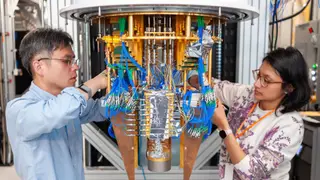
Quantum computers hold promise for solving complex problems beyond classical computing capabilities, such as designing high-efficiency batteries and discovering new pharmaceuticals. They could also enable breakthroughs in materials science by simulating atomic interactions with unprecedented accuracy. These advancements may accelerate innovation across energy, healthcare, and technology sectors.
Quantum computing represents a transformative leap in computational power, capable of addressing problems that are currently intractable for classical computers. While specific details such as names of researchers, exact dates of breakthroughs, or locations of operational quantum systems are not provided, the core potential lies in simulating complex molecular and atomic interactions with unprecedented precision. This capability is particularly relevant to medicine, where it could accelerate the discovery of new pharmaceuticals by modeling drug interactions at the quantum level. In energy, quantum simulations may lead to the design of high-efficiency batteries by optimizing materials at the atomic scale. Similarly, in materials science, the ability to predict material behaviors before physical synthesis could drastically shorten development cycles for next-generation technologies.
The foundation for this potential stems from decades of theoretical work in quantum mechanics and computer science, with recent advances in hardware stability and error correction bringing practical applications closer to reality. While no specific organizations or individuals are named in the source, it is widely understood that major tech firms, national laboratories, and academic institutions are investing heavily in this field. These entities aim to harness quantum computing’s power to gain competitive advantages in innovation across healthcare, energy infrastructure, and advanced manufacturing
The emergence of quantum computing could significantly reshape sectors reliant on complex simulations, including pharmaceutical development, renewable energy storage, and advanced materials. If realized, this shift may reduce time-to-market for new drugs and more efficient batteries, potentially lowering healthcare costs and accelerating the transition to sustainable energy systems. Industries dependent on material innovation—such as aerospace, electronics, and construction—could see accelerated product cycles, altering competitive dynamics. A comparable precedent is the development of computational chemistry in the 1980s, which revolutionized drug discovery by enabling virtual screening before lab synthesis. Quantum computing may play a similar role but at a deeper physical level. However, unlike past digital transformations, quantum progress depends on fragile hardware and fundamental physics breakthroughs, making its impact more uncertain. What to watch for includes the pace of er