Flexible molecular links enable unprecedented nanoparticle arrangements in new materials
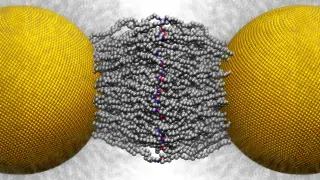
MIT researchers have overturned decades of materials science convention by showing that flexible molecular connectors can create entirely new crystal structures from nanoparticles. This breakthrough allows for precise control over material design, paving the way for innovative applications in electronics, medicine, and energy technologies.
In November 2026, researchers at the Massachusetts Institute of Technology (MIT), led by Professor Rob Macfarlane, demonstrated that flexible molecular connectors—contrary to decades of established materials science dogma—can enable the formation of previously unseen nanoparticle crystal structures. The team, including MIT PhD candidate Nicholas Sbalbi, undergraduate Hana Shinzawa, Matthew Ye PhD '26, and University of Delaware’s Stephen Kronenberger and Arthi Jayaraman, published their findings in *Nature Materials*, challenging the long-held belief that rigid ligands were essential for precise nanoparticle assembly. Their approach used highly flexible molecular links that adjust dynamically during self-assembly, allowing nanoparticles to form complex, stable superlattices not achievable with traditional rigid connectors. This breakthrough emerged from a deliberate effort to test the opposite of conventional wisdom: instead of minimizing flexibility to maintain structural control, they maximized it. The discovery hinges on the interplay between molecular flexibility and electrical charge in ligands, which govern how nanoparticles organize into new crystal forms.
For 20 years, materials scientists have relied on rigid ligands to fix particle orientations and prevent disorder during assembly. This approach, while effective for specific cases, limited the range of possible structures and hindered scalability. Macfarlane emphasized that prior methods were “bespoke”—effective on
This discovery could reshape the development of functional materials across multiple sectors. In electronics, the ability to engineer nanoparticle arrangements may lead to more efficient photonic devices or tunable semiconductors. In medicine, precisely structured nanoparticles might improve drug delivery systems by enabling targeted release mechanisms or enhanced imaging contrast. Energy applications—such as catalytic surfaces for hydrogen production or next-generation batteries—may benefit from materials with tailored surface geometries and electronic properties. The shift from rigid to flexible connectors may also reduce the complexity of synthetic processes, potentially lowering costs and increasing scalability compared to bespoke methods. A comparable precedent is the development of self-assembled monolayers in the 1980s, which revolutionized surface chemistry but required precise molecular design. This new approach may similarly open doors to adaptive, responsive materials. What