China Unveils Ambitious Lunar Crewed Mission Plan Targeting 2030 Landing
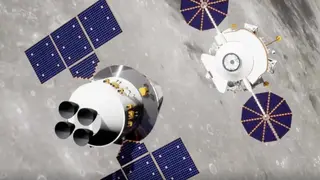
China has announced a detailed strategy to land taikonauts on the Moon before 2030, using a two-launch approach involving separate Long March-10 rockets for the Lanyue lunar lander and the Mengzhou crew capsule. The plan involves rendezvous in lunar orbit, with two astronauts descending to the surface via the lander while one remains in orbit, followed by a return journey to Earth aboard the crew capsule. Testing of key systems, including escape mechanisms and lander prototypes, is already underway as part of the mission's development phase.
On October 31, 2026, China unveiled its detailed plan to land taikonauts on the Moon before 2030 during the 7th Manned Space Symposium in Beijing, marking a pivotal step beyond its successful robotic Chang’e missions. The mission will employ a two-launch, lunar orbit rendezvous strategy using two Long March-10 rockets launched from Wenchang Space Launch Center in Hainan. One rocket will carry the Lanyue lunar lander, the other the Mengzhou crew capsule. After reaching lunar orbit, the two spacecraft will dock; two taikonauts will transfer to Lanyue for descent to the surface, while one remains aboard Mengzhou in orbit. Following surface operations using the Tansuo rover and wearing the Wangyu spacesuit, the pair will return to the lander, which will ascend and re-dock with Mengzhou before the crew returns to Earth. Key systems are already under development: emergency escape tests for Mengzhou, landing and takeoff trials for Lanyue, and low-altitude validation of Long March-10 have been completed. Uncrewed test flights of both spacecraft are planned prior to the crewed mission. The program builds on China’s achievements, including the first sample return from the Moon’s far side in June 2024 and its ongoing work on the Tiangong space station. The goal aligns with broader ambitions to establish an international lunar research station with Russia by the 2030s.
The mission reflects China’s strategic push to achieve second-to-none status in human spaceflight, following the U.S. A
China’s announced lunar crewed mission could significantly shift global space dynamics, reinforcing a multipolar era in space exploration where national ambitions compete with international cooperation. If successful, China would become only the second nation to land humans on the Moon, potentially altering perceptions of technological leadership and inspiring renewed investment in STEM education and public engagement in science. The emphasis on reusable systems, orbital rendezvous, and incremental testing may influence future mission designs across other spacefaring nations. This effort mirrors the Cold War-era space race but with a focus on long-term infrastructure rather than short-term prestige. Unlike the Apollo program’s singular focus, China’s approach appears more integrated with sustained presence goals—such as the planned lunar research station—suggesting a model that could shape future international collaboration or fragmentation in space governance. The U.S. response, parti