Markets Surge on Democratic Midterm Sweep, Volatility Plummets
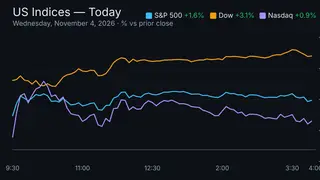
U.S. stock indices rallied sharply on Wednesday following a decisive Democratic victory in the 2026 midterm elections, which reduced political uncertainty and signaled potential legislative gridlock favorable to markets. The Dow Jones soared 3.03%, while tech-heavy indices like the Nasdaq and S&P 500 also posted gains, driven by optimism over stable policy and lower volatility as the VIX dropped 20.16%. Gold rose 3.44% amid a weakening dollar and falling Treasury yields, while energy stocks declined on speculation of diplomatic de-escalation in the Middle East.
On Wednesday, November 4, 2026, U.S. stock markets surged following a decisive Democratic victory in the midterm elections, which secured control of both the House and Senate. The Dow Jones Industrial Average rose 3.03% to close at 53,356.12, while the S&P 500 and Russell 2000 each gained 1.58%, reaching 7,688.62 and 2,856.95, respectively. The Nasdaq Composite added 1.44% to 25,736.51, driven by optimism over policy stability and reduced political risk. Market volatility plummeted as the VIX dropped 20.16% to 16.63, signaling a sharp decline in uncertainty. Gold rose 3.44% to $4,076.10 amid a weakening U.S. dollar and falling 10-year Treasury yields to 4.92%. Energy stocks were notably weaker, with WTI Crude plunging 7.92% to $88.48, as Vice President JD Vance attributed the GOP’s losses to the ongoing conflict in the Middle East, fueling speculation of a diplomatic de-escalation. Healthcare stocks led gains, with Electromedical & Electrotherapeutic Apparatus up 8.73% and General Medical & Surgical Hospitals rising 8.53%, reflecting expectations of increased federal funding. Conversely, infrastructure and tech hardware sectors declined, with Water, Sewer, Pipeline, Comm & Power Line Construction down 11.27% and Printed Circuit Boards falling 8.10%.
The broader context includes heightened market sensitivity to political outcomes, particularly around regulatory risk and fiscal policy. The Democratic sweep suggests a likely legislative gridlock, which markets often interpret
The market rally following the Democratic midterm sweep could signal a broader shift toward stability in financial markets, particularly for sectors sensitive to regulatory change. Investors may interpret gridlock as a positive, reducing fears of abrupt legislation that could disrupt corporate planning—especially in healthcare, infrastructure, and technology. This dynamic may benefit long-term investors seeking predictable policy environments but could also delay necessary reforms in areas like energy or climate policy. The sharp rise in gold and decline in Treasury yields suggest growing confidence in a soft landing scenario, potentially influencing Federal Reserve signaling in the coming months. A comparable case is the 2010 midterms, when Democrats retained control of Congress after a strong showing, leading to sustained market gains amid fiscal uncertainty. However, unlike then, today’s rally appears driven more by geopolitical optimism than economic policy clarity. What may unfold