Tech and AI Stocks Plunge Amid Election Fallout and Regulatory Fears
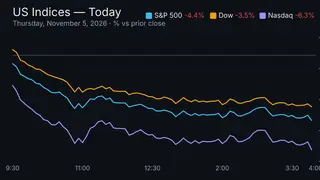
Thursday saw a dramatic market downturn as Wall Street reacted to a Democratic midterm sweep with a sharp sell-off in tech and AI stocks. The Nasdaq dropped 5.52%, its worst day in 18 months, led by semiconductor and data storage firms. Investors fled high-growth equities amid concerns over new regulations on data centers and potential policy shifts affecting AI infrastructure spending. Defensive sectors like healthcare and consumer staples outperformed as market volatility spiked and the VIX surged to its highest level since early 2026.
On Thursday, November 5, 2026, U.S. stock markets experienced a sharp downturn following a Democratic midterm sweep, triggering the Nasdaq’s worst single-day performance in 18 months with a 5.52% drop to 24,315.00. The S&P 500 fell 4.36%, the Dow Jones declined 3.44%, and the Russell 2000 dropped 4.45%. The VIX surged 69.48% to 28.15—the highest level since early 2026—signaling heightened investor anxiety. Tech and AI stocks bore the brunt of the sell-off, with semiconductor and computer storage firms plunging by 11.14% and 14.85%, respectively. Megacap tech firms Nvidia and AMD fell 9.3% and 17.3%, respectively, amid growing fears over new regulations targeting data centers and potential policy shifts that could disrupt AI infrastructure spending. These concerns were amplified by local ballot rejections of proposed data center projects, reinforcing investor worries about regulatory headwinds. In contrast, defensive sectors like healthcare and consumer staples outperformed, with Ophthalmic Goods and General Medical & Surgical Hospitals rising 3.52% and 3.31%, respectively. WTI crude oil rebounded 2.95% to $90.72, recovering from a prior 8% drop, as traders speculated on potential diplomatic shifts in the Iran conflict.
The market reaction reflects broader concerns about policy uncertainty following a sweeping Democratic victory, which may signal tighter regulation of technology infrastructure and data use. Investors are now reassessing the long-term viability of high-growth tech investments, particularly in AI and cloud computing, amid fears of increased oversight. While no specific legislation is cited, the sell-off suggests market participants anticipate regulatory scrutiny on data centers and AI deployment. The shift toward defensive sectors indicates a flight to safety, with gold rising 0.65% to $4,099.30. Upcoming economic data—including October Nonfarm Payrolls, CPI, PPI, and the US Budget Balance—may further shape sentiment. The outcome of these reports remains unknown, as does whether regulatory actions will materialize or if market volatility will persist.
The sharp sell-off in tech and AI stocks could signal a broader reevaluation of high-growth equities amid political uncertainty, potentially affecting innovation investment and long-term capital allocation in emerging technologies. Investors may become more cautious about backing AI infrastructure projects, which could slow deployment even as demand grows. This shift may disproportionately impact smaller tech firms and startups reliant on venture capital, while benefiting established defensive sectors like healthcare and consumer staples. The broader economy may see reduced spending on digital transformation if regulatory fears persist. A comparable earlier case is the 2018–2019 market correction following increased scrutiny of big tech companies, which led to a temporary pause in AI investment cycles. However, unlike then, today’s sell-off appears more politically driven than fundamentally based on earnings or valuation. The impact on global markets remains uncertain, particularly if similar regulatory concerns emerge elsewhere. What may follow is a period of consolidation, with investors awaiting clearer policy signals—especially from the upcoming November economic data and potential regulatory announcements.