AI Rally Falters as Fed Pressure and Regulatory Fears Trigger Market Retreat
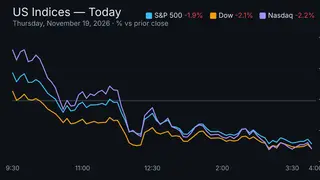
On Thursday, November 19, 2026, Wall Street saw a broad market decline despite the strong debut of Anthropic's IPO, as AI valuation fatigue and hawkish Federal Reserve commentary undermined sentiment. The Nasdaq fell 2.25%, the S&P 500 dropped 2.02%, and the Dow Jones declined 2.19%. Gold and silver prices tumbled as the US Dollar Index rose, while semiconductor stocks were hit by allegations linking AMD to a blacklisted Chinese server manufacturer.
On Thursday, November 19, 2026, major U.S. stock indices experienced sharp declines despite the high-profile initial public offering (IPO) of AI company Anthropic, which opened at $111.50—34% above its $83 offering price. The Nasdaq fell 2.25% to close at 23,879.20, the S&P 500 dropped 2.02% to 7,175.83, and the Dow Jones lost 2.19% to end at 49,097.06. The sell-off was broad-based, with the Russell 2000 shedding 2.18%, and the VIX volatility index surged 15.80% to 28.44, signaling heightened investor fear. The downturn was driven by a confluence of factors: growing skepticism toward AI stock valuations, renewed hawkish commentary from the Federal Reserve, and a damaging report linking AMD to a blacklisted Chinese server manufacturer, which caused the chipmaker’s stock to plunge 7.72%. Gold and silver prices also collapsed, with spot gold dropping 3.17% to $3,623.10, as the US Dollar Index climbed to its highest level since April 2025, reflecting expectations of a December rate hike. Retail and consumer sectors were hit hard, with Apparel down 4.55% and Williams-Sonoma plunging 15.2% due to weak revenue guidance.
The broader context includes a recent surge in AI-related stock enthusiasm that has now cooled amid concerns over sustainability and regulatory scrutiny. The Federal Reserve’s hawkish stance, reinforced by FOMC minutes suggesting a 95% chance of a rate hike in December, has tightened financial conditions and pressured growth stocks. Key players include the Federal Reserve, which seeks to maintain price stability; tech firms like Anthropic and AMD, whose market performance is tied to investor sentiment and geopolitical risk; and institutional investors monitoring macroeconomic signals. Unresolved questions remain about the long-term viability of AI valuations, the outcome of regulatory investigations into semiconductor supply chains, and whether the Fed will maintain its current stance despite economic headwinds. Upcoming data releases—including the November CPI report on December 10 and the Q3 GDP estimate on November 25—will be critical in shaping near-term market direction.
The market retreat on November 19, 2026, reflects a broader shift in investor psychology, where euphoria over AI innovation is being tempered by concerns about valuation bubbles, regulatory overreach, and macroeconomic tightening. This could affect retail investors who have poured capital into high-growth tech stocks, potentially leading to reduced participation in future IPOs. The downturn in semiconductors and related infrastructure may ripple through global supply chains, especially given the allegations against AMD, which could prompt further scrutiny of foreign supply ties. Financial institutions and asset managers may adjust risk exposure, potentially reducing allocations to tech and growth equities. A comparable earlier case is the dot-com bust of 2000, where overvaluation and regulatory uncertainty led to a prolonged market correction. While today’s AI rally is not necessarily unsustainable, the current sell-off may signal a recalibration rather than a collapse. Investors should watch for whether the Fed’s hawkish tone persists, how companies like Anthropic and AMD respond to the allegations, and whether upcoming economic data triggers a shift in monetary policy. The next few weeks could determine whether this is a temporary correction or the start of a broader reassessment of tech-driven growth.