Tiny Asteroid Temporarily Captured by Earth’s Gravity, Expected to Depart in 2027
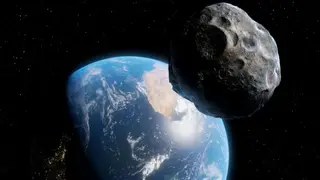
A small asteroid named 2026 QQ8, measuring about one meter across, has been temporarily captured by Earth's gravity and is expected to remain in orbit until December 2027. Scientists confirmed it is a natural object, not space debris, based on its orbital characteristics and observations from ground-based telescopes. The object will break free from Earth’s gravitational influence in 2027 and may pass close again in 2058, though it won’t be captured then.
A small asteroid designated 2026 QQ8, approximately one meter wide, was captured by Earth’s gravity in April and confirmed as a natural object in late October by the Minor Planet Center. It will remain temporarily bound to Earth until December 2027, reaching a closest approach of about 353,000 miles (568,000 km)—slightly farther than the Moon’s average distance. Unlike artificial satellites, this object is not human-made; its orbital characteristics and observations from the University of Hawaii’s 2.2-meter telescope and the Lowell Discovery Telescope confirmed its status as a natural asteroid. Scientists believe it originated from the Sun’s gravitational influence, entering Earth’s Hill Sphere—where planetary gravity dominates—during a close pass in April. It follows an orbit around the Sun that takes about 359 days, slightly shorter than Earth’s year, which helps explain why it was captured this time but not during previous near-Earth encounters, such as in 1965. The object is expected to make another close approach in 2058 but will not be captured again due to differing orbital dynamics. This follows the earlier temporary capture of 2024 PT5, a larger asteroid (33 feet wide) that orbited Earth for nearly two months and is believed to have originated from the Arjuna asteroid group. The discovery of 2026 QQ8 adds to growing interest in transient natural satellites, with researchers at institutions like the University of Hawaii and Lowell Observatory playing key roles in tracking and classifying such objects.
The temporary capture of small asteroids like 2026 QQ8 may influence public perception of space threats and planetary defense strategies, even though these objects pose no danger. While not a hazard, their detection highlights the increasing capability of ground-based telescopes to monitor near-Earth objects (NEOs), potentially improving early warning systems for larger, more dangerous asteroids. The scientific community benefits from such events by refining models of gravitational capture and orbital mechanics, particularly in understanding how small bodies interact with Earth’s Hill Sphere. Comparable cases include 2024 PT5 and the quasi-moon 2025 PN7, which has been in a stable Earth-like orbit for decades. These discoveries could inform future space missions targeting temporary satellites for sample return or study. However, no immediate commercial or policy shifts are expected, as such objects remain too small and short-lived for practical exploitation. What may emerge is greater public engagement with astronomy through real-time tracking of these fleeting visitors, possibly boosting interest in citizen science initiatives. The long-term significance lies in refining predictive models for asteroid behavior—especially for those that could one day be captured or pose a risk—making continued monitoring essential.