Astronomers Discover Possible Second-Generation Planet Forming Around a White Dwarf
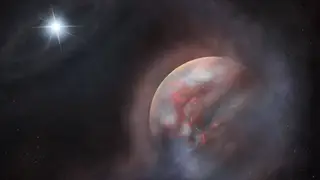
Researchers at the University of Warwick have found evidence suggesting a planet may have formed from the remnants of a dead star orbiting the white dwarf HS 0209+0832. The star's ultraviolet spectrum shows unexpected absorption features indicating recent infall of heavy elements, unlike typical debris from destroyed planets. This discovery hints at a new phase in planetary systems where worlds can emerge long after their parent stars have died.
Astronomers at the University of Warwick have uncovered compelling evidence suggesting a second-generation planet may be forming around the white dwarf HS 0209+0832, located approximately 170 light-years from Earth. The discovery hinges on ultraviolet spectral data collected by the Hubble Space Telescope in 1999, which revealed an unusual abundance of heavy elements—particularly niobium, copper, and zinc—in the star’s atmosphere. These elements are not typically found in significant quantities on white dwarfs due to their intense gravity, which pulls heavier elements downward within days. The presence of these materials implies recent infall from a source beyond typical planetary debris. Further analysis using updated atomic data confirmed niobium’s dominance, with its abundance over 1,000 times that in the Sun—suggesting material enriched by late-stage stellar nucleosynthesis. The team also detected a periodic dimming pattern in brightness from NASA’s TESS satellite, recurring every 4.399 days and indicating a possible Jupiter-sized planet orbiting just six million kilometers from the white dwarf. This proximity suggests intense radiation is evaporating the planet’s atmosphere, feeding material back toward the star. The findings, published in Nature Astronomy, challenge the long-held assumption that planetary formation ends with stellar death.
The breakthrough builds on decades of research into metal-enriched white dwarfs, where astronomers have traditionally inferred the presence of destroyed planets or asteroids. However, the chemical signature at HS 0209+0832—especially the absence of iron and silicon but high niobium—is inconsistent with known planetary compositions. Instead, it aligns with material produced during the s-process in asymptotic giant branch stars, indicating that the planet may have formed from gas and dust ejected during the star’s red giant phase. The team, led by doctoral researcher Jamie Williams, used archival data from NASA’s Far Ultraviolet Spectroscopic Explorer to confirm their findings. While no direct imaging of the planet exists, the combination of spectral anomalies and periodic photometric variations provides strong indirect evidence. What remains unresolved is whether this object qualifies as a true planet or if it represents a different kind of celestial body—such as a failed star or a dense clump of debris. Future observations with next-generation telescopes may help determine its mass and composition, potentially confirming the existence of a new class of planetary systems.
This discovery could reshape how astronomers understand planetary system evolution, suggesting that planets aren’t just relics of stellar youth but can emerge in post-stellar environments. If confirmed, it implies that planetary formation is not a one-time event tied to star birth but may occur in multiple phases across a star’s life cycle. This has implications for astrobiology and the search for habitable worlds, as such systems might host planets in extreme conditions—potentially with dynamic atmospheres shaped by intense radiation. The finding also highlights the value of reanalyzing old data with new tools, demonstrating how archival observations can yield breakthroughs decades after collection. A comparable precedent is the discovery of exoplanets around pulsars in the 1990s, which initially seemed impossible given their violent origins but ultimately expanded the known pathways for planet formation. Here, the mechanism—planet formation from stellar ejecta—could open new avenues in astrophysics and planetary science. Institutions like NASA and ESA may prioritize follow-up missions to study such systems, while private space ventures might explore indirect detection methods. What to watch for next includes confirmation via direct imaging or radial velocity measurements, as well as the search for similar signatures in other metal-enriched white dwarfs—potentially revealing a hidden population of second-generation planets.