Shakespeare’s Much Ado About Nothing Reimagined as a 90s Rave on Broadway
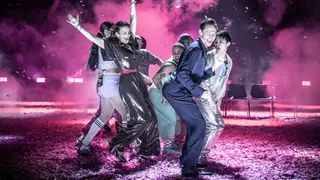
Tom Hiddleston and Hayley Atwell star in Jamie Lloyd’s vibrant revival of Much Ado About Nothing at New York’s Winter Garden Theatre, transforming the classic Shakespearean comedy into a high-energy dance spectacle with ’90s rave aesthetics and house music. The production, which marks the play’s first Broadway appearance since 1984, features choreography and staging inspired by Ibiza nightlife. It runs through January 10, 2027, and is based on a sold-out London run.
Tom Hiddleston and Hayley Atwell star in Jamie Lloyd’s radical reimagining of Shakespeare’s Much Ado About Nothing, which opened at New York’s Winter Garden Theatre on November 11, 2026, and will run through January 10, 2027. This marks the play’s first Broadway appearance since its 1984 production, following a sold-out run in London that drew acclaim for transforming the classic comedy into a high-energy, ’90s rave spectacle. The production fuses Shakespearean text with house music, choreography inspired by Ibiza nightlife, and immersive stage design, creating a dance-driven theatrical experience. Atwell makes her Broadway debut in the role of Beatrice, while Hiddleston reprises his acclaimed London performance as Benedick. Supporting roles are played by Mara Huf as Hero, James Phoon as Claudio, and Tim Steed as Don John. The production is directed and produced by Jamie Lloyd, known for innovative stagings that blend classical texts with contemporary culture.
The play’s roots trace back to the late 1590s, with its first recorded performance in 1612–13 during a royal wedding celebration. It has since seen numerous revivals, including notable Broadway runs in 1959 (with John Gielgud and Margaret Leighton) and 1984 (Derek Jacobi and Sinead Cusack). The 1993 film adaptation by Kenneth Branagh, starring Emma Thompson and himself, remains a landmark in cinematic Shakespeare. This new revival builds on a long tradition of reinterpreting the play—ranging from period costumes to modern settings—but uniquely embraces digital-age nostalgia through its rave aesthetic. The decision to bring it to Broadway after two decades reflects a broader trend of reviving classic works with genre-bending, youth-oriented formats.
The creative team, led by Lloyd, aims to attract new audiences to Shakespeare by merging highbrow literature with pop culture energy. The production’s success in London likely influenced its New York transfer, signaling confidence in the commercial viability of such experimental adaptations. However, questions remain about long-term audience reception and whether this format can sustain interest beyond a limited run. It is not yet known if the show will tour or be adapted for film, nor how critics and traditional theatergoers will respond to the radical departure from naturalistic staging.
This revival could signal a broader shift in how classical theater engages younger, digitally native audiences who may find traditional Shakespeare inaccessible. By embedding the play within a ’90s rave aesthetic—complete with music, dance, and immersive visuals—it may help bridge generational gaps in cultural consumption. The success of this production might encourage other theaters to experiment with genre fusion, potentially reshaping how classic works are marketed and performed. Comparable to the 2013 “Hamilton” phenomenon, which redefined musical theater by blending hip-hop with history, this adaptation could become a case study in making legacy art form relevant through cultural remixing. However, such bold reinterpretations may also provoke debate about artistic integrity and the commodification of Shakespeare. While the production’s commercial appeal is evident, its long-term impact on theater education or traditional performance standards remains uncertain. Theaters may face pressure to prioritize spectacle over textual fidelity, potentially alienating core audiences. What to watch for next includes whether other classic plays receive similar treatment—especially those with romantic or comedic themes—and how streaming platforms might adapt such productions for wider reach. The experiment could either inspire a wave of innovation or be seen as a fleeting trend.