Taurid Meteor Shower Peaks in November 2026 with Up to 10 Fireballs per Hour
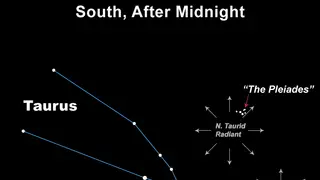
The Taurid meteor shower, consisting of the South and North Taurids, is active from late October through early December 2026, with peak activity expected on November 5 (South Taurids) and November 12 (North Taurids). Observers can expect up to 10 meteors per hour, including bright fireballs, best seen around midnight when the constellation Taurus is highest in the sky. The meteors originate from debris left by Comet Encke.
The Taurid meteor shower, comprising the South and North Taurids, will peak in November 2026 with up to 10 meteors per hour during overlapping activity periods—specifically on November 5 (South Taurids) and November 12 (North Taurids), both at around 18–19 UTC. These meteors originate from debris left by Comet Encke, a periodic comet with an orbit that has fragmented over time into the so-called Encke Complex. The South Taurids are active from September 23 to November 12, while the North Taurids run from October 13 to December 2, with their highest visibility around midnight when the constellation Taurus is highest in the sky. The new moon on November 9, 2026, will provide dark skies ideal for observation, minimizing interference. Notably, fireballs—meteors brighter than magnitude -3—are expected at a rate of up to 7% during exceptional years, with past notable displays in 2008, 2015, and 2022. The next predicted outburst is anticipated in 2032.
The parent body of the Northern Taurids is believed to be asteroid 2004 TG10, discovered by the Spacewatch program in 2004, which shares an orbital path with Comet Encke. Scientists theorize that around 20,000 years ago, a larger object broke apart, forming the Encke Complex, including both the comet and multiple asteroids. Recent studies suggest that no single asteroid produces the Northern Taurids; instead, at least 10 related objects may contribute. This complexity arises from long-term gravitational perturbations and solar radiation altering debris trajectories over centuries. The American Meteor Society encourages public reporting of fireballs to help track these events, while researchers like the late Don Machholz contributed foundational work on comet-asteroid relationships. What remains unresolved is whether future observations will confirm the exact number and identity of contributing bodies, or if 2032’s predicted outburst will align with current models.
The Taurid meteor shower’s 2026 peak may inspire widespread public interest in amateur astronomy, particularly among stargazers and photography enthusiasts who rely on dark-sky conditions and precise timing. With minimal moonlight due to the November 9 new moon, observers across the Northern Hemisphere could experience enhanced visibility, potentially boosting participation in citizen science initiatives like fireball reporting through the American Meteor Society. This engagement may strengthen community ties around shared celestial events and increase demand for astronomy education resources, stargazing apps, and dark-sky tourism. Comparable to the 2015 Taurid outburst that drew global media attention and viral video coverage, this event could similarly elevate public awareness of near-Earth objects and planetary defense research. While not a direct threat, such meteor displays may influence how space agencies frame long-term monitoring of debris fields—especially given the Encke Complex’s link to potential future impacts. The scientific community may use these observations to refine models of comet fragmentation and orbital drift, which could inform asteroid deflection strategies or satellite collision avoidance systems. However, no immediate economic or policy shifts are expected. What could emerge is a growing public expectation for predictable celestial spectacles, potentially pressuring institutions to improve real-time sky alerts and educational outreach. The next key moment to watch will be the 2032 predicted fireball swarm, which may either validate current models or reveal gaps in understanding of long-term meteor stream evolution.