Radio Pulsations from White Dwarf Uncover Storms on Distant Sun-Like Star
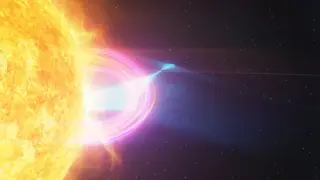
Astronomers at Curtin University's ICRAR detected radio pulses every 7.9 minutes from a white dwarf in the binary system GPM J071507-114153, which orbits a Sun-like star. The signal’s motion confirmed the pulses originate near or on the white dwarf, allowing researchers to observe stellar flares and a plasma prominence on the companion star. These findings, published in Nature Astronomy, mark the first time radio emissions from such a system have revealed storm activity on a distant star over 5,000 light-years away.
Astronomers at Curtin University’s International Centre for Radio Astronomy Research (ICRAR) detected periodic radio pulses every 7.9 minutes from a binary system designated GPM J071507-114153, located over 5,000 light-years away. This system consists of a low-mass white dwarf orbiting a Sun-like G-type star, marking the first time such a signal has been traced to a white dwarf paired with a star similar to our Sun. The pulses were confirmed through analysis of over 100 hours of radio data processed at the Pawsey Supercomputing Research Centre. Crucially, the observed orbital motion of the white dwarf—detected via shifts in the pulse timing—indicates that the emissions originate near or on the white dwarf itself. This allowed researchers to observe stellar flares on the Sun-like companion, akin to Earth’s aurorae, and a passing occultation by what is likely a plasma prominence—a large magnetic loop erupting from the star’s surface. These findings, published in Nature Astronomy on November 12, 2026, represent a breakthrough in detecting storm activity on distant stars using radio astronomy. The discovery builds on earlier work identifying only about a dozen long-period transients (LPTs), most of which involved white dwarfs paired with cooler red dwarfs. Until now, the source of the radio emissions in such systems remained uncertain. Dr. Sam McSweeney and Dr. Natasha Hurley-Walker led the team, leveraging the Square Kilometre Array Observatory’s commissioning efforts to achieve this precision. What remains unresolved is whether the pulses originate from the white dwarf’s surface, its magnetosphere, or an accretion process. Future observations may clarify the emission mechanism and whether similar phenomena occur in other LPTs with Sun-like companions.
This discovery could deepen public engagement with astrophysics by demonstrating how radio astronomy reveals dynamic stellar processes across vast distances, potentially inspiring interest in space science education and outreach. The ability to detect storms on a star over 5,000 light-years away may influence funding priorities for large-scale observatories like the Square Kilometre Array, as it underscores their potential to uncover previously invisible phenomena. Institutions involved—such as ICRAR and Pawsey—may gain stronger international collaboration opportunities, particularly in data-intensive research. Comparable to how the discovery of exoplanets reshaped planetary science in the 1990s, this finding may catalyze new models for stellar magnetic activity and binary interactions. It could also prompt re-evaluation of existing LPT catalogs, encouraging deeper scrutiny of other systems with similar radio signatures. While no immediate commercial applications are evident, the data processing techniques developed here may benefit broader fields like machine learning in big data astronomy. What to watch for next includes confirmation of whether this emission mechanism is common among Sun-like companions in binary systems, and whether future telescopes can detect such events in real time—potentially enabling early warnings for extreme space weather events on Earth if similar processes are found closer to home.