James Webb Telescope Observes Star Merger in Andromeda Galaxy
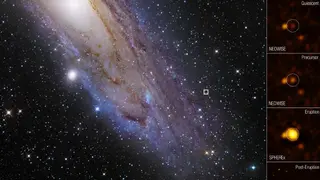
The James Webb Space Telescope captured the first real-time observation of a star merger in the Andromeda galaxy, where a smaller star spiraled into a massive supergiant named AT 2025abao. The event, detected after an eruption in October 2025, showed the smaller star merged with the giant in just seven orbits over about seven years. The merger likely rejuvenated the system and expelled significant material, challenging existing models of stellar evolution.
In October 2025, the James Webb Space Telescope (JWST) captured the first real-time observation of a stellar merger in the Andromeda galaxy, specifically the collision of a smaller star—designated Little Bao, with about 0.7 times the Sun’s mass—into a massive supergiant named Big Bao, formally known as AT 2025abao. The event, detected after an initial eruption in 2023 by NASA’s NEOWISE mission, culminated in a merger that occurred over just seven orbital cycles, or approximately seven years, far faster than the thousands of orbits typically expected in such binary systems. The merger expelled an estimated 0.1 to 0.2 solar masses of material and likely rejuvenated the system, challenging long-standing models of common-envelope evolution. Webb’s early follow-up—just 47 days after the eruption peaked—provided unprecedented data on the system’s pre-, during-, and post-merger states, enabling detailed reconstruction of the process. The primary star, Big Bao, was modeled as having seven times the Sun’s mass, 350 times its radius, and 18,000 times its luminosity. The discovery was led by Dr. Viraj Karambelkar of Columbia University, who noted the rarity of such real-time observations due to the unpredictability of stellar mergers. While the merger is strongly indicated, confirmation remains pending further observations. The findings, published in Nature in 2026, suggest that current stellar evolution models may underestimate energy redistribution during such events.
This observation could significantly influence how astronomers model binary star systems and stellar evolution, particularly in dense galactic environments like Andromeda. The rapid merger challenges assumptions about orbital decay and energy dissipation, potentially prompting revisions in astrophysical simulations used in both academic research and space mission planning. Institutions relying on accurate stellar models—such as NASA, ESA, and academic observatories—may need to recalibrate predictive tools for future surveys. The event also highlights the value of sustained monitoring programs like NEOWISE and the strategic deployment of powerful instruments like JWST, which may become standard for catching transient phenomena. A comparable earlier case is the 2019 detection of a star being torn apart by a black hole (a tidal disruption event), which similarly reshaped understanding of extreme stellar interactions. However, unlike that case, this merger offers a rare chance to observe the entire process from initiation to aftermath. The broader impact may extend to public engagement with space science, as such dramatic events capture widespread attention. Future missions may prioritize real-time follow-up capabilities, and private space ventures could explore opportunities in transient event monitoring. What remains uncertain is whether such mergers are common in other galaxies or if this event was an anomaly.