Carbon Market Supply Outpaces Demand as $71 Billion in Credits Await Buyers Despite Skepticism
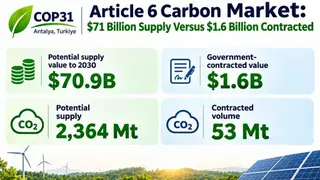
At COP31 in Antalya, Turkiye, a new report reveals that 2.36 billion tonnes of carbon credits could be available by 2030, creating a potential $70.9 billion pipeline, yet only $1.6 billion in government contracts have been signed. Sovereign buyers have committed to just 53 million tonnes—2.2% of the projected supply—with only 151,566 tonnes of internationally transferred mitigation outcomes (ITMOs) actually exchanged. Buyers remain cautious due to concerns over verified emission reductions and project integrity.
At COP31 in Antalya, Turkiye, a new report revealed that 2.36 billion tonnes of carbon credits could be available by 2030—valued at $70.9 billion—yet only $1.6 billion in government contracts have been signed, with just 53 million tonnes committed by sovereign buyers, representing just 2.2% of projected supply. Only 151,566 tonnes of internationally transferred mitigation outcomes (ITMOs) have actually been exchanged, underscoring a massive disconnect between supply potential and actual transaction volume. Despite growing national climate commitments, estimated demand by 2030 stands at around 200 million tonnes, worth $6 billion, suggesting that current contracting lags significantly behind ambition. Since October 2025, governments have announced tenders covering 27.3 million tonnes, including Singapore’s procurement programme and Norway’s agreement to buy up to 12 million tonnes from Indonesia—yet these announcements do not confirm delivery or payment. The discrepancy reflects deep skepticism about project integrity, additionality, and verification, particularly in forest-based credits like REDD+, which range from $0.15 to $9.20 per tonne, far below government purchase prices of $36.58 (Switzerland) and $27.30 (Singapore). Key players include Switzerland, Singapore, Norway, and Japan, each pursuing different mechanisms—Article 6, JCM—with varying standards. India leads in historical voluntary credit issuance with 405 million tonnes since 2004 and is developing a domestic carbon market, with 490 industrial facilities completing their first compliance reporting cycle in July 2026. What remains unresolved is whether verification systems can scale to meet demand, or if the market will remain constrained by trust deficits.
The imbalance between carbon credit supply and actual demand could undermine confidence in Article 6 mechanisms as a tool for climate finance, particularly if governments continue to sign contracts without ensuring delivery of verified reductions. This may discourage private investment in high-integrity projects, especially in developing nations where such credits are intended to fund sustainable development. The voluntary market’s slight decline in retirements—down 3.2% from 174.5 million tonnes in 2024 to 169 million in 2025—suggests weakening corporate appetite despite net-zero pledges, potentially signaling a shift toward stricter due diligence or internal abatement strategies. Comparable to the early days of the Kyoto Protocol’s Clean Development Mechanism, where supply outpaced demand and integrity concerns plagued credibility, today’s market may be entering a similar phase of consolidation. If verification standards remain inconsistent, credit prices could stabilize at lower levels, favoring low-cost projects but risking environmental harm. What to watch for is whether new regulatory frameworks—such as India’s emerging compliance system or enhanced Article 6 rules—can build trust and trigger a shift from announcements to verified transactions. The outcome may determine whether carbon markets evolve into reliable climate finance tools or remain sidelined by skepticism.