Green Hydrogen Ambition Lags Behind Reality as $130 Billion Invested but Only 1.7 Million Tonnes Produced
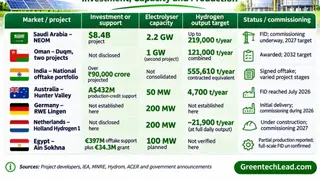
Global green hydrogen projects have attracted over $130 billion in committed investment, yet only 1.7 million tonnes of annual production are operational, according to the Hydrogen Council’s 2026 assessment. Despite rapid growth in electrolyser capacity—doubling to over 4 GW in 2025—most projects face delays or cancellations, with 22 million tonnes of announced capacity at risk of missing the 2030 target. Saudi Arabia’s NEOM project remains a key example nearing commercial production.
In November 2026, at COP31 in Antalya, Turkey, global green hydrogen ambitions were put under scrutiny as new data revealed a stark divergence between investment and output. Despite over $130 billion in committed funding across more than 1,950 announced projects, only 1.7 million tonnes of annual green hydrogen production are currently operational, according to the Hydrogen Council’s Global Hydrogen Compass 2026. While electrolyser capacity doubled to exceed 4 GW by 2025—led by China’s dominance in installations—most projects remain stalled. Of the 579 projects that have reached final investment decision (FID) or beyond, only a fraction are on track for commercial operation by 2030. The IEA reports that 22 million tonnes of announced production capacity now risk missing the 2030 target due to delays and cancellations. Saudi Arabia’s NEOM Green Hydrogen Project, a $8.4 billion endeavor by ACWA Power, Air Products, and NEOM, stands out as one of the few nearing completion, with commissioning underway in August 2026 and commercial operations expected by 2027. It aims to produce up to 219,000 tonnes annually, supported by a 30-year ammonia off-take agreement. Meanwhile, Oman announced two new projects during COP31 targeting 121,000 tonnes of hydrogen annually by 2032 through auctions with significant incentives like 90% land lease reductions. India has secured 555,610 tonnes in annual green hydrogen off-take contracts—worth $9.5 billion—driven by agreements with IHI, L&T, and Reliance, though these represent only about 11% of its 2030 target. Australia’s Hunter Valley project reached FID at 50 MW, but larger projects face setbacks. The core issue remains: while financing and planning are widespread, execution lags due to unresolved permitting, supply chain constraints, and uncertain offtake agreements.
The gap between green hydrogen investment and actual production could slow the global energy transition’s momentum, particularly in hard-to-abate sectors like heavy industry and long-haul transport. Countries relying on export-driven hydrogen economies—such as Saudi Arabia, Oman, and Australia—may face reputational and economic risks if projects fail to deliver on time, undermining climate credibility ahead of major international commitments. Meanwhile, industries dependent on green hydrogen derivatives, such as fertilizer producers and steelmakers, may experience supply chain disruptions or increased costs if targets are not met. The situation echoes the early days of solar PV deployment in the 2010s, where aggressive announcements outpaced manufacturing and grid integration, leading to market corrections. Today, similar risks loom: over-optimism in project pipelines could lead to investor fatigue or policy backtracking if deliverables remain unmet. What’s next may depend on whether governments and corporations shift from symbolic commitments to enforceable contracts, accelerated permitting, and transparent progress tracking. The real test will be whether 2027 commercial operations at NEOM and other FID projects can demonstrate scalability—something that could either catalyze broader confidence or deepen skepticism in the sector’s viability.